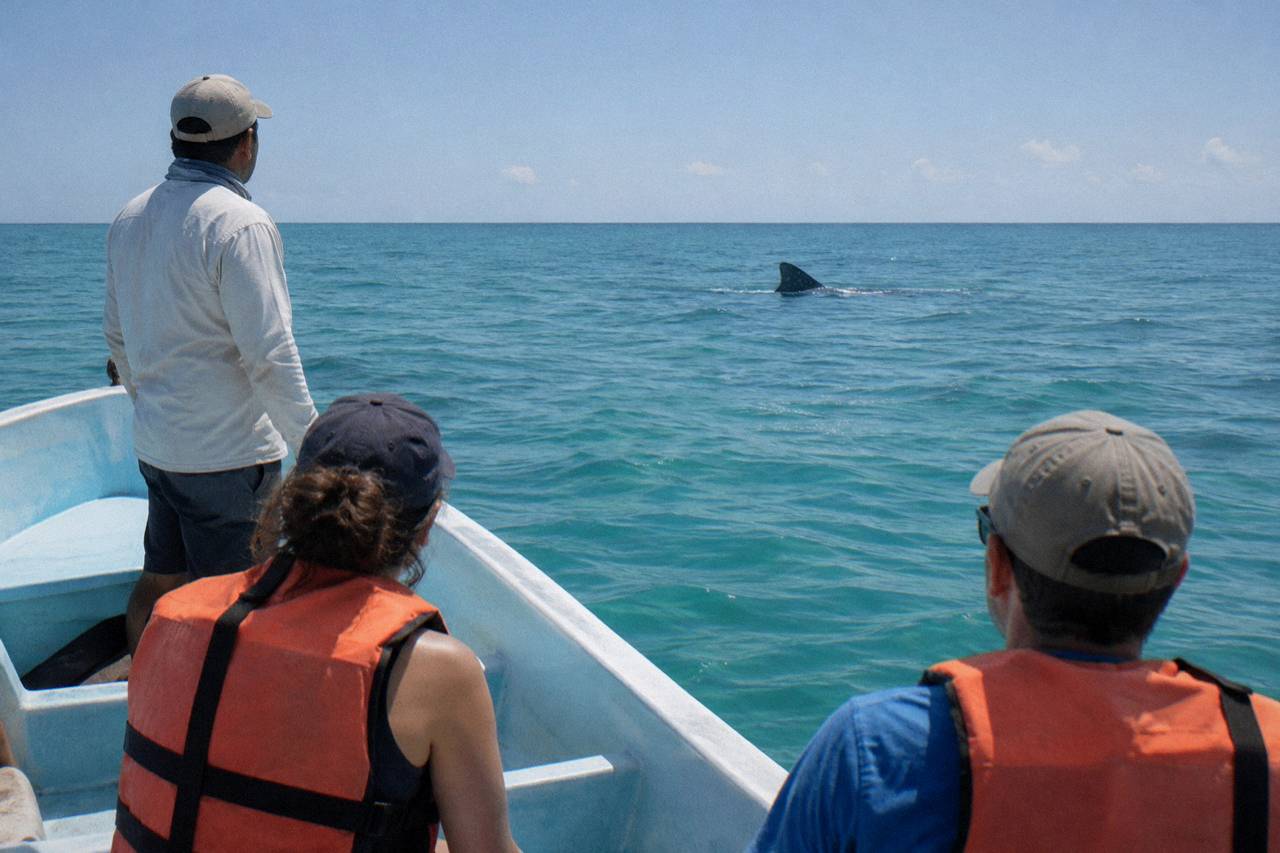
Why Is Touching A Whale Shark Illegal?
The federal rule behind the no-touch rule on Holbox whale shark swims, why contact harms the animal, and what guides do the moment a hand reaches out.
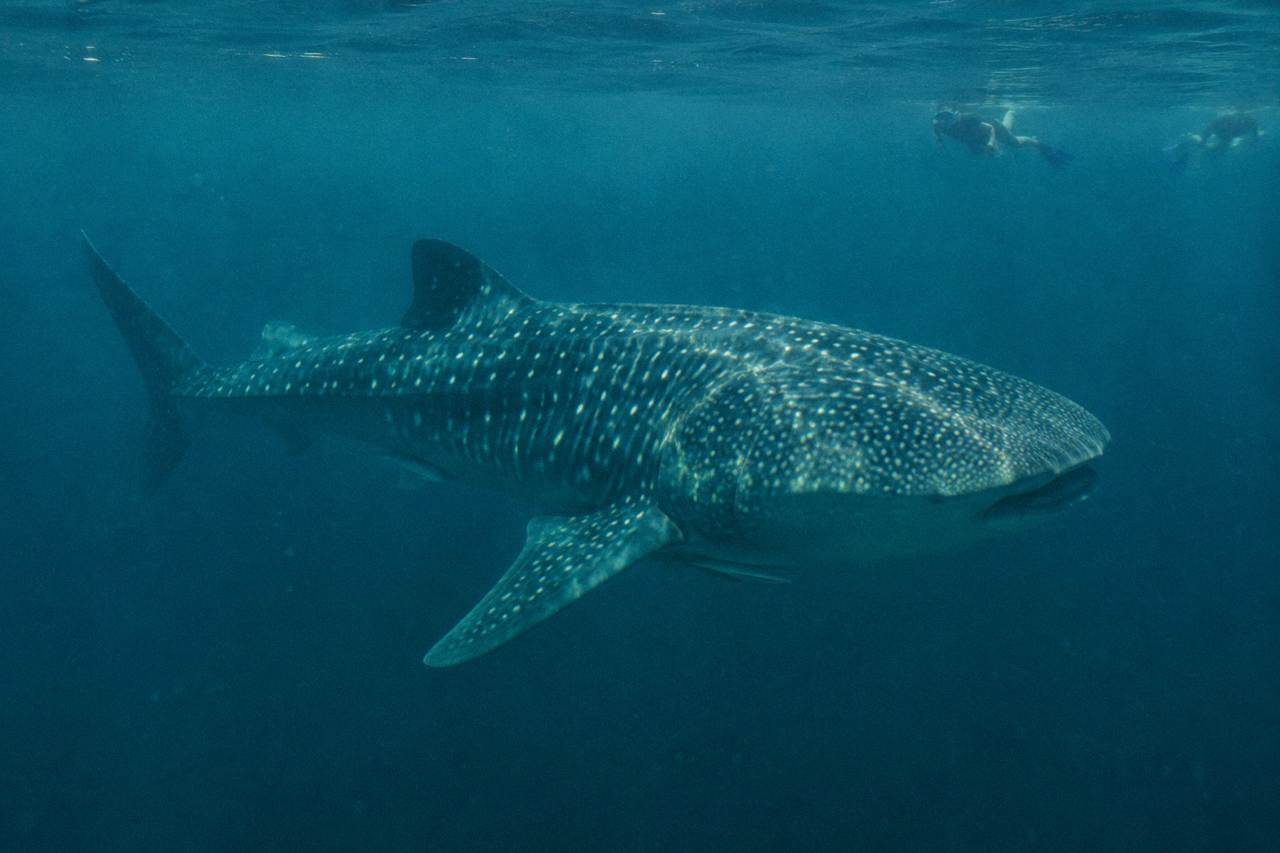
Touching a whale shark is illegal in Mexico because the federal swimming standard, NOM-171-SEMARNAT-2018, explicitly prohibits physical contact with, harming, injuring or riding the animal, and it further bans harassing the shark or blocking its path. Whale sharks swim in protected federal waters around Holbox, so the rule carries the weight of national wildlife law, not just a tour operator's house policy.
The exact wording matters here. The official text of NOM-171 published in the Diario Oficial de la Federación sets out, under numeral 4.7.1.1, that physical contact, causing harm, injury or riding a whale shark is not permitted. Two companion clauses extend the ban: 4.7.1.2 covers harassment and 4.7.1.3 covers blocking the animal's natural path. Together they close almost every loophole a well-meaning swimmer might imagine. A quick brush of the hand is contact. Hanging on is riding. Swimming in front of the animal to force an encounter is blocking its path, and the norm separately forbids swimming in front of the shark altogether.
The 2026 season on this coast ran from 15 May to 17 September under the SEMARNAT notice for the Yum Balam, Tiburón Ballena and Caribe Mexicano protected areas, and the season is now closed. Next season, typically opening from mid-May, will operate under the same federal standard. If you are reading this while planning a swim from Holbox next summer, the no-touch rule is the single most important piece of the briefing you will get on the boat, and it is worth understanding before you are treading water beside an animal the length of a bus.
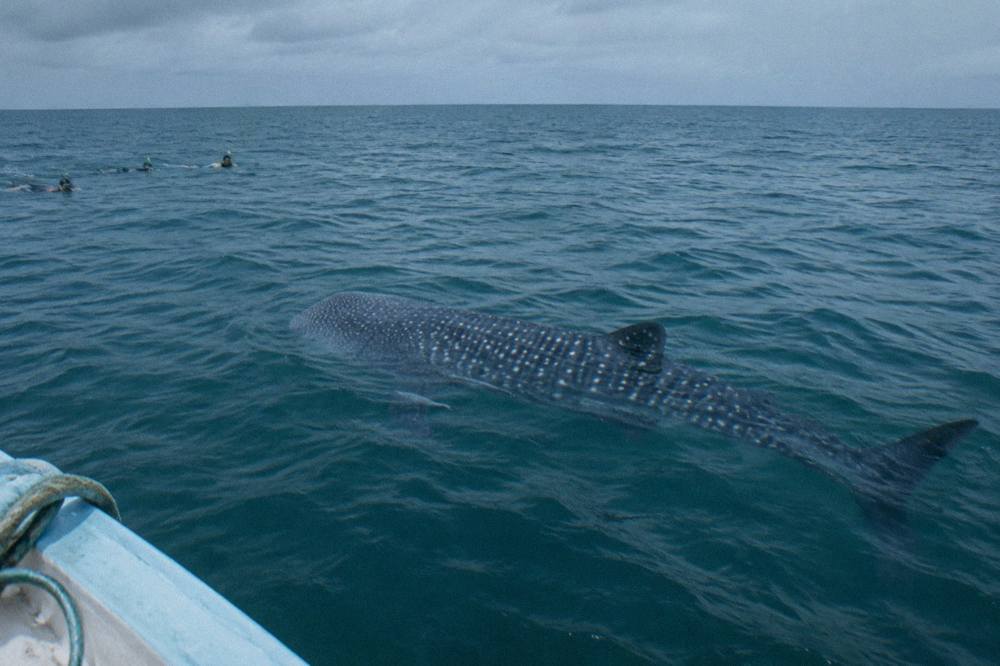
The rule exists because whale sharks are wildlife, not attractions. They gather off this coast to feed on plankton in the warm summer water, and every authorized interaction in Mexico is framed as non-extractive wildlife use: observation and swimming under conditions designed to keep the animal's behaviour unchanged. Touch changes that. It is the clearest line in the whole framework, which is why guides repeat it in every pre-swim briefing on every licensed boat from Holbox, Isla Mujeres and Cancun alike.
What Does NOM-171 Actually Say About Contact?
NOM-171-SEMARNAT-2018 states that it is not permitted to have physical contact with a whale shark, to harm, injure or ride it, to harass it, or to block its path. The same standard sets a maximum of 30 minutes per boat around one shark, requires other boats to wait 50 metres away, and fixes approach distances of no closer than 5 metres for the vessel.
The standard is a long document covering everything from boat length to sunscreen, and the no-touch clauses sit in its prohibitions section. Reading them in order gives a sense of how deliberately they were written. Numeral 4.7.1.1 covers contact, harm and riding in a single line, because in practice the three usually happen together: a swimmer who grabs the animal is simultaneously making contact and interfering with its movement. The harassment and path-blocking clauses catch everything else, from chasing a shark that is trying to leave to positioning a group directly in its line of travel.
Around those core prohibitions sits a web of supporting rules that make accidental contact less likely. The table below pulls the key clauses together as they apply to a swimmer in the water.
| Rule in NOM-171 | Numeral | What it means in the water |
|---|---|---|
| No physical contact, harm, injury or riding | 4.7.1.1 | Hands off entirely, no grabbing, no holding on |
| No harassing the shark | 4.7.1.2 | No chasing, splashing at or pursuing the animal |
| No blocking its path | 4.7.1.3 | Never position yourself in front of its line of travel |
| One boat per shark, 30 minutes maximum | 4.4.3 | Other boats wait 50 metres away until the rotation ends |
| Boat stays 5 metres clear | 4.4.1 and 4.4.4 | The vessel never closes on the animal |
| Guide keeps the group together | 4.5.6 | Swimmers stay 2 metres from the head, 3 metres from the tail |
| Quiet water entry, no jumping | 4.5.3 and 4.5.5 | Swimmers slip in from a boat placed ahead at about 45 degrees |
| Biodegradable sunscreen only | 4.5.1 | Applied before boarding, never at the swim site |
| Mask, fins, snorkel, vest or wetsuit | 4.5.2 | The vest also slows swimmers down, keeping distance true |
| No flash, artificial light or selfie stick | 4.5.10 | Photos are allowed, reaching rigs are not |
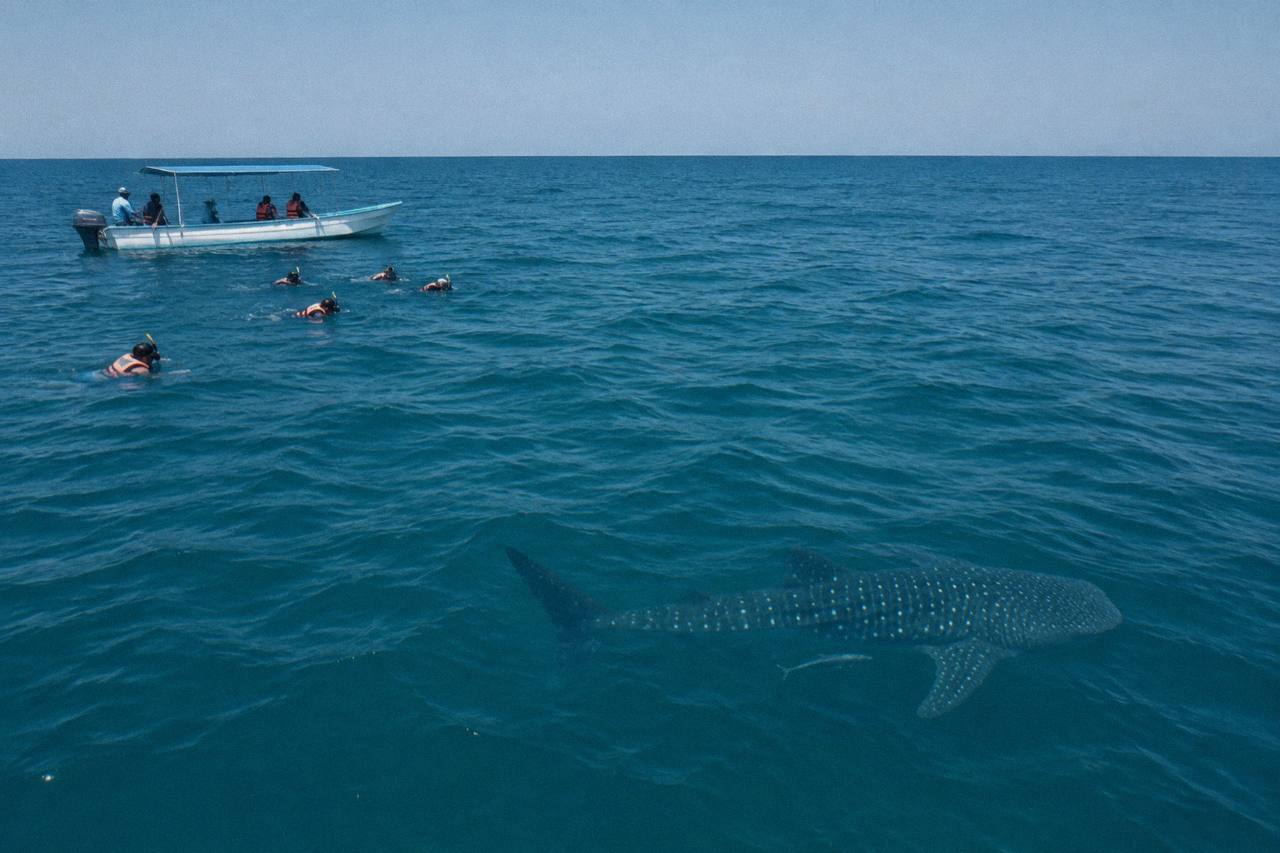
Swimmers enter the water quietly from a boat positioned ahead of the shark at roughly 45 degrees. The guide keeps the group together and to the side of the animal, 2 metres clear of the head and 3 metres from the tail fin. Each authorized boat flies an identification pennant and is limited to 11 metres in length. None of this is decoration; it is a system built so that a wild animal can keep feeding, in a feeding area, with hundreds of people in the water each week.
The full framework is worth reading for anyone who cares about the ethics of the activity, and the rules are summarized for swimmers in our guide to Mexico's whale shark swimming rules. The short version is that every restriction points the same way: the shark decides where it goes, and everyone else adapts.
6-Hour Swim, VIP Holbox Experience
6 hours
★ 4.6 · 243 reviews · From $178
Whale shark swims ended for 2026 on 17 September. The 2027 season dates have not been announced, so open calendars may stay blank for now.
Check availability →Why Does One Touch Harm The Animal?
A whale shark's skin is a living organ, and contact can damage the protective mucus layer and the skin surface that shield it from infection and parasites. Beyond the physical harm, a touch usually means a swimmer has closed the distance the rules mandate, which stresses the animal and can interrupt feeding, the entire reason it is there.
Whale sharks are filter feeders, the largest fish in the ocean, and they come to the aggregation zones off Holbox, Contoy and Cabo Catoche because the summer water is thick with plankton. Feeding is their whole agenda. A swimmer who reaches out is inserting themselves into that agenda, and the animal's options are limited: it can change depth, change course, or leave the area entirely. Guides on this coast describe sharks that dive when boats crowd them, and repeated disturbance in a feeding zone has a cumulative cost that no single touch captures.
The physical argument is real too, even without inventing numbers. Shark skin carries a mucus layer that plays a role in protection against bacteria and parasites, and that layer is disturbed by handling. In the open sea the same principle holds: watch, swim alongside, never touch. In the open ocean there is no vet and no record, which is precisely why the rule has to be preventive rather than reactive. The standard does not wait for an injury; it bans the contact itself.
There is a human-safety side as well, though it is secondary. A whale shark is a huge animal moving with real force, and its skin is abrasive, like very rough sandpaper. The skin is abrasive, covered in dermal denticles, the tiny tooth-like structures that coat a shark's body. The animal poses no predatory threat; it filters plankton, and the reported risks to swimmers are boats, crowding and seasickness, not the shark. But a hand on a moving animal is a hand doing something the body did not sign up for.
What Happens The Moment A Swimmer Reaches Out?
Guides are trained to keep swimmers a safe distance from the shark, and if you drift too close, a guide will typically step in and pull you back toward the group or the boat. On licensed Holbox boats a specialised guide stays in the water with a small group of swimmers, and the exact swimmer-to-guide limit is set by the protected-area management programme, with operators differing.
The intervention is usually physical and immediate, because it has to be. A guide swimming beside the group will grab an arm, block a path, or call the whole rotation short the instant a hand starts moving toward the animal. There is no warning system, no first and second chance; the cost of a completed touch is borne entirely by the shark, so the guide absorbs the awkwardness instead. Most swimmers comply instantly and sheepishly, and in many cases the reach was reflex rather than intent, an animal the size of a truck gliding past within metres of your face does strange things to impulse control.
The formal consequences beyond the guide's intervention sit with the federal enforcement chain. Authorized activity in these waters is supervised by CONANP, the national protected areas commission, which authorizes the permits that licensed boats carry during the season. An operator whose swimmers break the rules risks its authorization, which is why operators take briefings so seriously and why a guide will end your swim without hesitation. No fine amount for individual swimmers is published; the operative fact is that the conduct is prohibited by federal standard and enforced through the licensing system that every legal boat depends on.
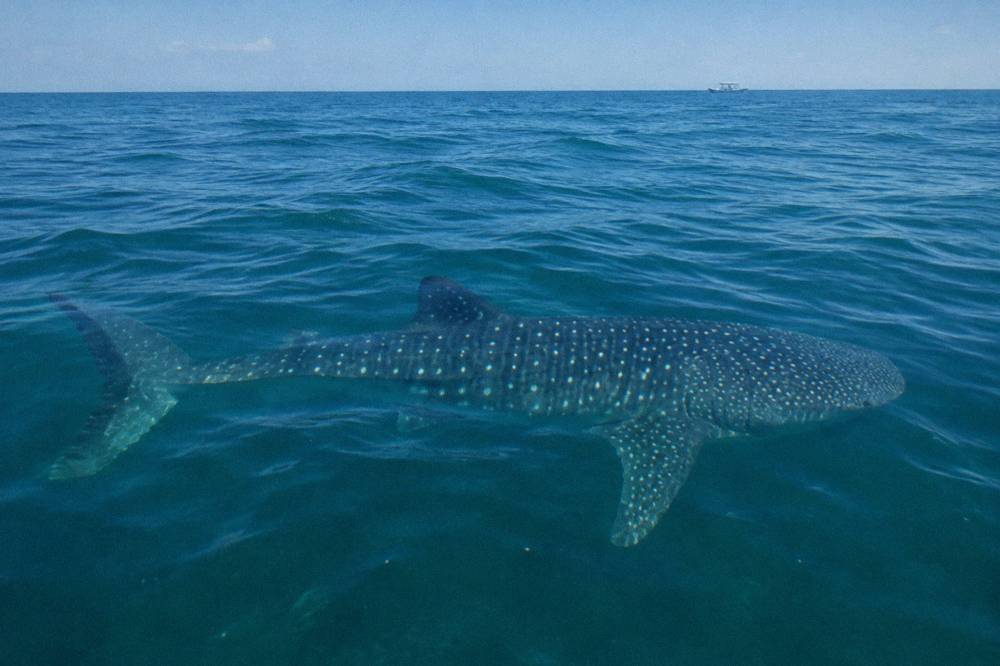
Operators also structure the whole experience to reduce the odds of a reach. The best-reviewed Holbox departures keep their groups small and their guides in the water, which is exactly the format the all-inclusive listing from VIP Holbox Experience describes: a guide in the water with swimmers, gear included, from $209 per person, with a 4.9 rating from 267 reviews. The eco tour from Xtreme Holbox takes the same approach with a certified bilingual guide and hotel pickup in Holbox, from $190 per person, rated 4.6 from 57 reviews, with two supervised water entries per couple. You can compare both against the classic six-hour adventure from VIP Holbox Experience in the Holbox whale shark tour comparison.
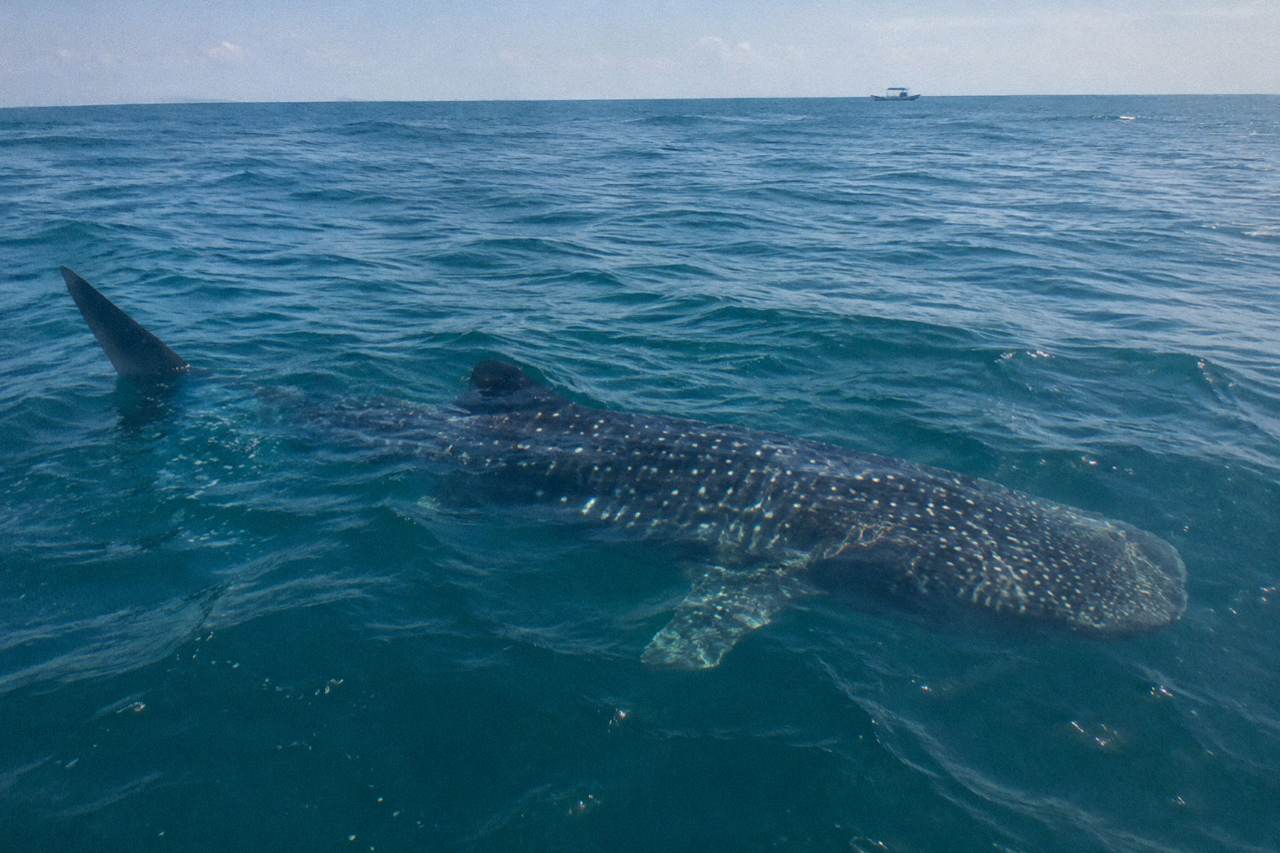
Whale Shark Swims From Holbox Island · 7 hours
★ 4.6 · 57 reviews · From $190
Whale shark swims ended for 2026 on 17 September. The 2027 season dates have not been announced, so open calendars may stay blank for now.
Check availability →Does The Rule Apply To Every Whale Shark Swim In Mexico?
Yes. NOM-171-SEMARNAT-2018 applies nationwide to non-extractive whale shark observation and swimming, covering every authorized operator in Quintana Roo and beyond, from Holbox and Isla Mujeres to La Paz on the other coast. The season dates and permit numbers change by area and year; the no-touch rule does not.
The 2026 notice for this coast, published under the standard, set the season from 15 May to 17 September and covered the Yum Balam, Tiburón Ballena and Caribe Mexicano protected areas; the notice on the federal environment ministry's site also leaves boat numbers per zone to CONANP. In 2026, CONANP authorized 146 permits across 14 cooperatives, split 92 for Isla Mujeres, 48 for Holbox and 6 for Chiquila, per a July 2026 news report quoting the tourism cooperatives. Every one of those permit holders, and every swimmer on their boats, operates under the same contact prohibitions.
That uniformity is worth emphasizing because a surprising number of visitors assume the rules are looser on smaller boats or remote islands. They are not. A private charter out of Holbox and a ten-traveller shared boat out of Cancun answer to identical clauses on contact, distance, time limits and equipment. What differs is context: Holbox departures use small lanchas and are commonly described as quieter on the water, while the Cancun and Isla Mujeres hubs put more boats on the same shared feeding grounds. The rules are the constant; the scene around you is the variable.
For anyone comparing bases, our breakdown of Holbox against Cancun and Isla Mujeres covers the differences in boat style, ride time and price, with Holbox departures running from $178 to $210 per person on the shared listings and the private swim at from $1,246 per group. The rules conversation, though, is identical wherever the boat leaves from.
How Do Guides Keep Swimmers Far Enough Away?
The standard fixes the geometry in advance: the boat drops swimmers ahead of the shark at about 45 degrees, the guide keeps the group together, swimmers stay 2 metres to the side of the head and 3 metres from the tail, and swimming in front of the animal is banned outright. Distance is maintained by positioning, not by willpower.
This is the part of the system most visitors never see the engineering of. Because the shark is moving forward and the swimmers are placed ahead and to the side, the animal's own momentum carries it past the group, and the guide's job is to hold the group's position rather than chase. Chasing is what breaks the geometry: the moment swimmers kick after the shark, the 2-metre and 3-metre clearances collapse and the guide has to reset the whole rotation. The 30-minute per-boat limit and the 50-metre standoff for waiting boats exist for the same reason, keeping the total pressure on any one animal bounded.
The equipment rules pull in the same direction. The life vest or wetsuit that the standard requires does double duty as a speed limiter; a swimmer in a vest simply cannot overhaul a whale shark in open water. The ban on flash and artificial light, and on selfie sticks, removes the other classic trigger for contact, the swimmer who stops watching the animal in order to frame it. Photos are allowed; rigs that make swimmers reach and drift are not. Anyone planning to photograph the swim will find the full kit list in our article on what to bring on a Holbox whale shark tour.
None of this works without a guide who is in the water and watching hands, which is the practical argument for listings that emphasize guide supervision. The six-hour VIP Holbox Experience adventure, from $178 per person and rated 4.6 from 243 reviews, is one of the most-reviewed Holbox departures, and the listing describes a maximum of 10 travelers per booking group. Small numbers in the water are not a luxury on this activity; they are the mechanism by which a federal no-touch rule survives contact with human excitement.
Is The No-Touch Rule About Ethics Or About Law?
Both, and they point the same way. The law makes contact a prohibited act under a federal wildlife standard; the ethics argument is that a wild animal feeding in its own habitat should be able to continue doing so unchanged by tourism. The rule is the enforceable edge of a broader idea: the swim is a guest's privilege, not the animal's job.
Holbox sits inside the Yum Balam protected area; the neighbouring Whale Shark Biosphere Reserve covers about 146,000 hectares, running from Isla Contoy to Bahía de la Ascensión along the coast, and the island's tourism economy depends on that landscape staying healthy. Whale shark tourism here is a conservation economy in the plain sense: permits fund and structure protection, and the operators who hold them have a direct interest in aggregations returning each May. A swimmer who touches a shark is free-riding on a system everyone else on the water is paying to maintain.
The rule also protects the credibility of the activity itself. Whale shark swimming has faced fair questions about crowding and disturbance, and reviews across operators on this coast include both praise for small-boat intimacy and complaints about busy days with circling boats. The no-touch rule, and the distances around it, are the part of the framework that answers those questions. When swimmers follow it, the encounter remains an observation of wild behaviour; when they do not, it becomes something the animal pays for. Visitors who want the deeper version of this argument can read our piece on whether Holbox whale shark tours are ethical.
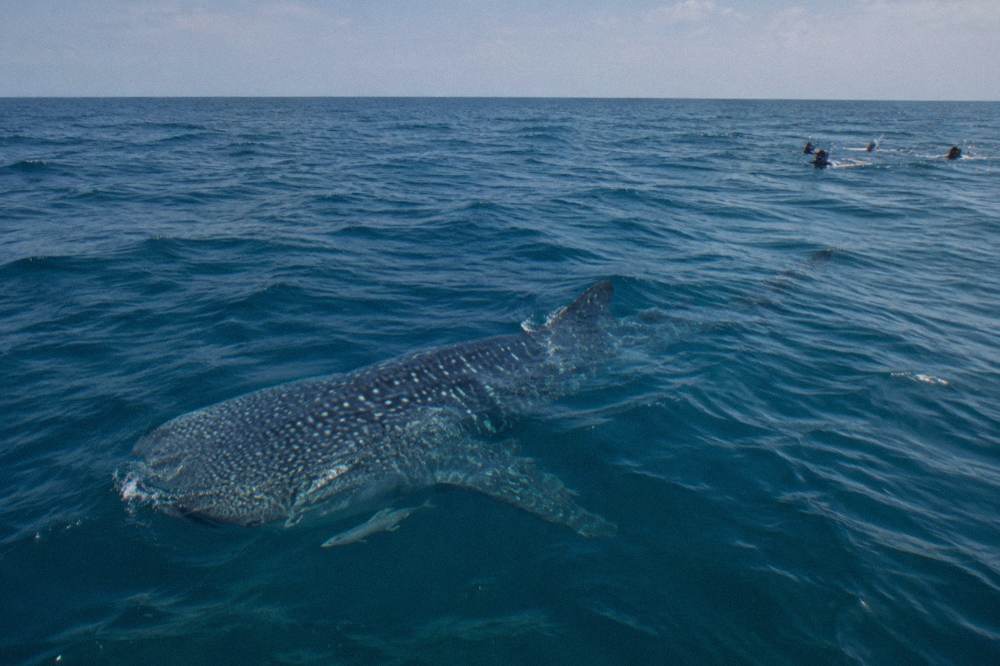
One caveat belongs here: no rule set guarantees a perfect encounter, and no operator can promise sightings, water clarity or calm seas. What the rules do guarantee is that if the encounter happens, it happens on the shark's terms. That is the whole bargain, and it is a good one.
What Should You Do Differently On The Day?
Listen to the briefing, stay beside your guide, let the shark pass you rather than kicking toward it, and keep your hands to yourself without exception. If you feel the urge to reach out, the correct move is to float and let the animal's own motion close the distance to the legal minimum, never past it.
The practical advice is short because the system is short. Everything that makes a swim safe for the shark is decided before you enter the water: the boat's position, the group's formation, the guide's placement. Your only job in the water is to hold your position, keep your fins down and your hands in, and watch. Swimmers who internalize this get longer, closer, calmer encounters, because guides trust them and sharks do not dive away from them. Swimmers who chase get one short rotation and a firm hand on the shoulder.
A few concrete habits help. Look at the guide, not just the shark, especially as the animal closes; the guide will signal direction and distance constantly. Keep your arms crossed or streamlined rather than trailing, because trailing hands drift. If the shark turns toward the group, do not back-paddle in a panic; the guide will reposition everyone. And treat the photo question with the same discipline: no flash, no selfie stick, and no reaching the camera toward the animal. A mid-range waterproof camera or a GoPro on a short body mount, held close, does the work without breaking the geometry.
Preparation on land matters too. Bring only biodegradable sunscreen and apply it well before boarding, wear the vest or wetsuit the operator provides, and if you are prone to motion sickness, plan for it, because the ride out to the feeding grounds can run long and a seasick swimmer is a less controlled swimmer. The full packing rundown covers the rest, and the operator's listing states exactly what is included on each departure, from breakfast and ceviche to snorkel gear.
Why Do The Rules Keep Getting Stricter, Not Looser?
Because the pressure on the animals keeps growing. Quintana Roo's whale shark zones host a licensed fleet of 146 permitted boats each season, and every rule in NOM-171, from boat length to the 30-minute cap, exists to cap the total load on a shared wild population whose numbers regulators cannot simply top up.
The direction of travel across the years has been one way. The current standard sets fixed distances, fixed swim times and fixed equipment requirements, and only boats operating under CONANP permits may run swims in these waters. Enforcement attention has grown alongside it, with the protected-area authorities monitoring activity through the season. There is no sign of any 2026 weakening of the contact rules, and any claim of a future change would be invention.
For swimmers, the trend is actually good news. Stricter rules have pushed operators toward the format that works best anyway: small groups, guides in the water, short rotations, longer observation from the boat. The listings that thrive on this coast are the ones built around supervision, which is why Holbox swim options such as the all-inclusive swim, the supervised eco tour and the six-hour adventure all use guide-in-water formats with included gear and free cancellation, so you can lock a date for next season without betting the fare on the weather.
Planning the wider trip around the swim? The Holbox Island Whale Shark Tours homepage carries the three-question trip picker and the full departure comparison, and our month-by-month season guide lays out when the water warms and when the season peaks. Next season, typically from mid-May, the sharks will be back on the feeding grounds, and the rules that protect them will be waiting on the boat, read aloud before anyone gets wet. Touch nothing, stay beside your guide, and you will have done the whole thing right.
Common Questions About Touching A Whale Shark
Can you touch a whale shark if it swims into you?
No. The rule prohibits contact regardless of who initiates it. If a whale shark closes the distance, the swimmer's obligation is to stay calm, keep hands and fins in, and let the guide manage the situation. Guides treat any contact event, even incidental, as a reason to reset the rotation.
What happens if you touch a whale shark on a tour?
The guide ends your swim immediately and pulls you back to the group or the boat. The operator faces the licensing consequences, since authorized activity is supervised by the federal protected-area and environmental enforcement authorities during the season. No individual fine amount appears in the official material.
Why does touching harm a whale shark if it is so big?
Size does not protect its skin. The mucus layer on a shark's skin helps defend against infection and parasites, and contact disturbs it. A touch also means the swimmer has broken the mandated distance, which interrupts feeding and can drive the animal out of the aggregation zone it came to feed in.
Do the no-touch rules apply on private tours too?
Yes. NOM-171 applies to every authorized operator nationwide, private or shared. A private charter out of Holbox answers to the same contact, distance and time rules as a shared boat from Cancun or Isla Mujeres; only the group size and the scene on the water differ.