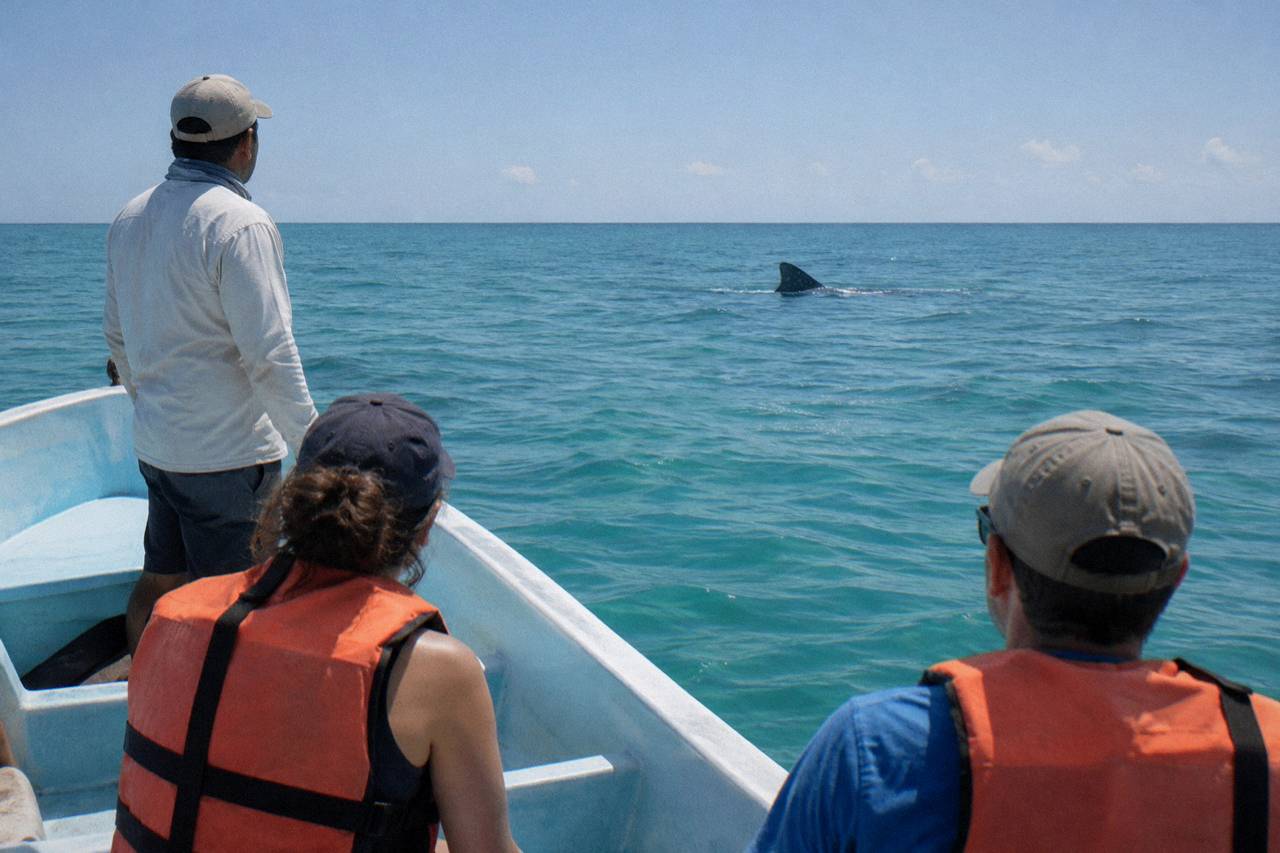
Swimming With Whale Sharks In Mexico: The Official Rules
Every whale shark swim in Mexico, including every departure from Holbox, runs under one federal rulebook. Here is what NOM-171 actually says, and how to spot an operator that follows it.
Short answer
Swimming with whale sharks in Mexico is regulated by NOM-171-SEMARNAT-2018, a federal standard published in the Official Gazette. Boats stay 5 metres from the shark, one boat at a time for up to 30 minutes, swimmers stay 2 metres from the head and 3 metres from the tail, and only biodegradable sunscreen is allowed. The 2026 season ran 15 May to 17 September.
Swimming next to the largest fish in the ocean is not a free-for-all in Mexico. It is governed by a federal standard called NOM-171-SEMARNAT-2018, published in the Diario Oficial de la Federación, the Mexican government's official gazette, which sets distances, boat behaviour, time limits, equipment and prohibitions for every authorised whale shark swim in the country. The rules apply whether your boat leaves from Holbox, Chiquila, Cancun or Isla Mujeres, and they exist for one reason: the sharks keep coming back because the encounter is managed rather than chased. If all those rules make you wonder whether you need to be a strong swimmer, the guide to swimming ability on a Holbox whale shark tour explains why floating is the main skill required.
The 2026 season in Quintana Roo closed on 17 September 2026 under the SEMARNAT notice that sets the annual window, and no swims run between seasons. If you are reading this while planning a trip, you are planning for next season, which typically opens from mid-May when the new notice is published. Understanding the rules now is genuinely useful, because the fastest way to vet an operator is to ask about them, and the Holbox Island Whale Shark Tours pages here exist to make that comparison easy.
What Rules Apply When You Swim With Whale Sharks In Mexico?
Every whale shark swim in Mexico runs under NOM-171-SEMARNAT-2018, a federal standard that regulates non-extractive observation and swimming nationwide, applied locally by CONANP in the Yum Balam reserve. It covers the Yum Balam reserve at Holbox, the Whale Shark Biosphere Reserve and the Caribe Mexicano reserve, and every authorised operator, guide and boat in those zones operates inside it.
The full text of the norm is public on the Official Gazette page of the federal government, and it is worth skimming before you book, because it tells you exactly what your guide is required to do. The standard covers vessel length, approach speed, the geometry of the drop-off, the equipment you must wear and a long list of prohibited behaviour. Operators must be authorised, guides must be trained, and tourists must be briefed on the code of conduct before anyone enters the water.
Each season, SEMARNAT also publishes an annual notice that opens and closes the swim window. The 2026 notice set the season from 15 May to 17 September 2026 and states that the number of authorised boats per zone is announced by CONANP. In practice, most operators run roughly from the start of June to mid-September, but the official dates are the notice's, and the 2027 notice has not been published yet; prior notices appeared around May.
Because the rules are federal, a swim from Holbox and a swim from Isla Mujeres operate under the same conduct code. What differs is the boat, the crowd and the ride out, which is a separate question we compare in the guide to Holbox versus Cancun versus Isla Mujeres departures.
How Close Can You Get To A Whale Shark In Mexico?
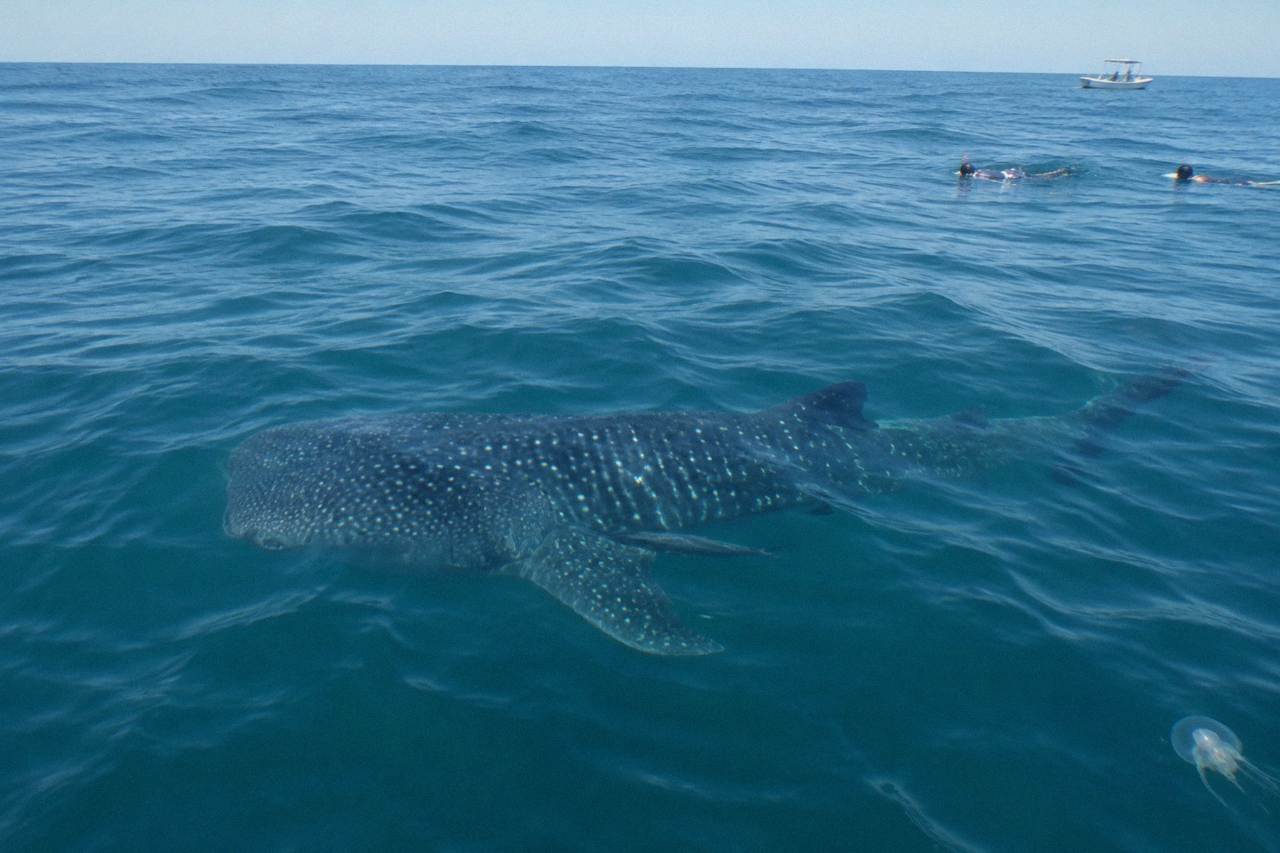
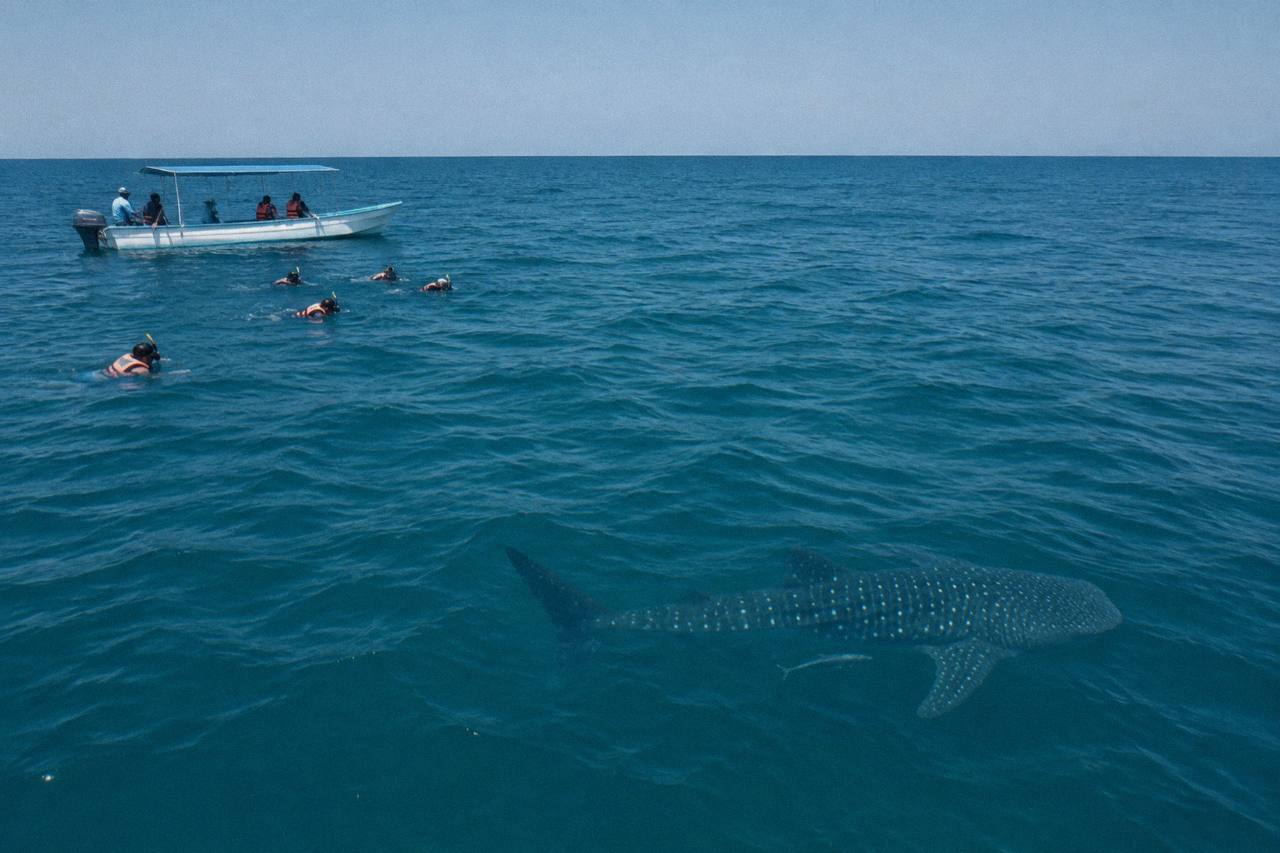
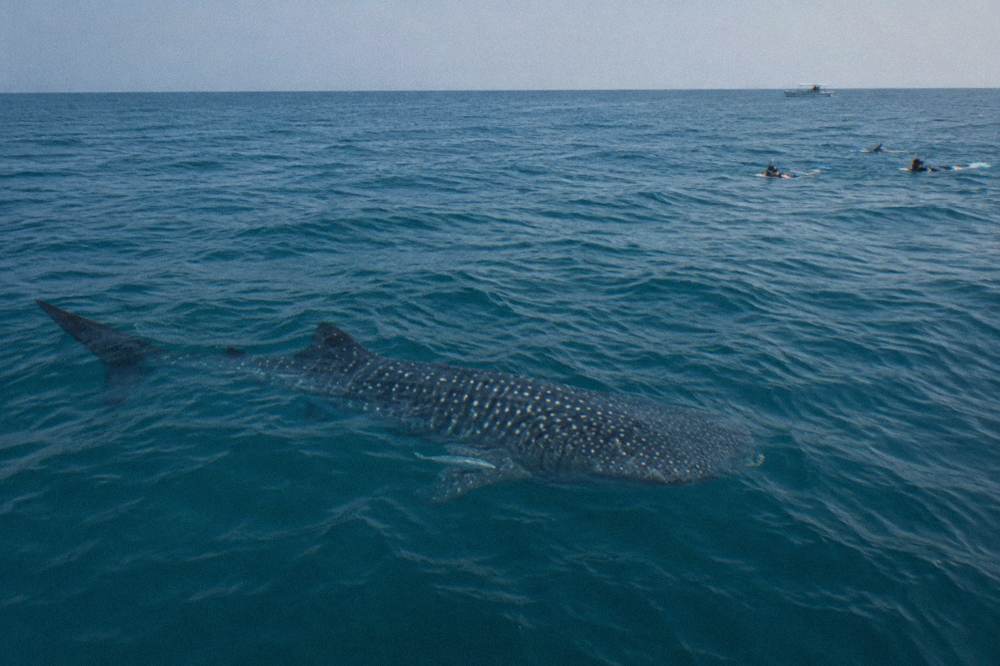
Federal rules set the distances on both sides of the encounter: a boat may not come closer than 5 metres to a whale shark, and swimmers must stay 2 metres to the side of the head and 3 metres from the tail fin. Waiting boats hold 50 metres back, and swimming in front of the shark is not allowed at any point.
The geometry is deliberate. Whale sharks are filter feeders that feed while moving forward, so the rules protect the animal's path rather than just its body. Your guide drops you in from the side, never the front, and you swim parallel to the shark as it passes. A specialised guide stays with a small group of swimmers and keeps the group together; the exact limit on swimmers per guide is set by the protected-area management programme, and operators differ, so ask your operator how they run their rotations rather than assuming a fixed number.
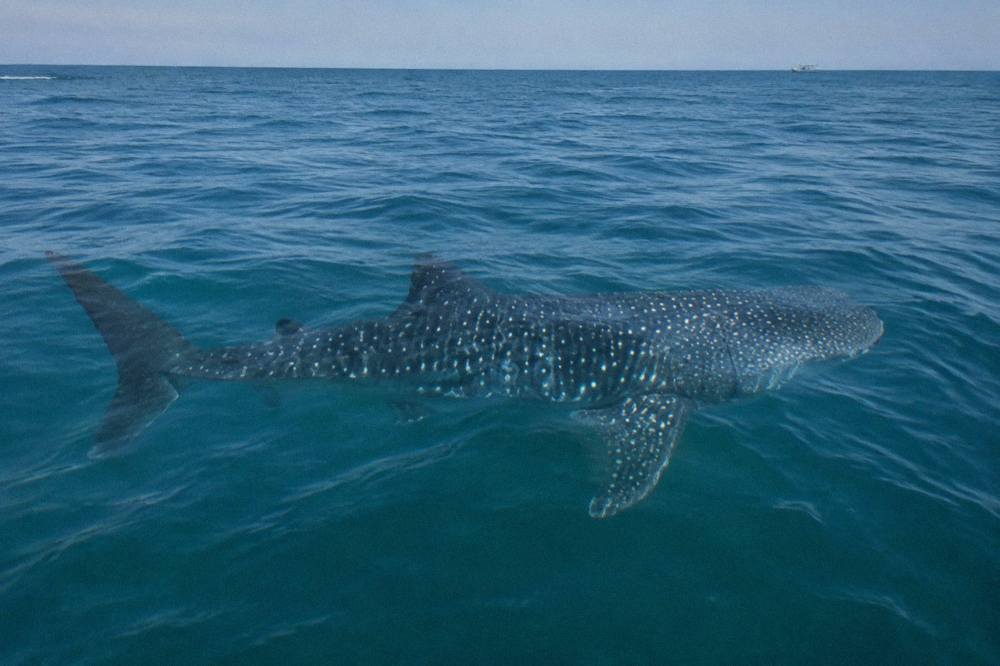
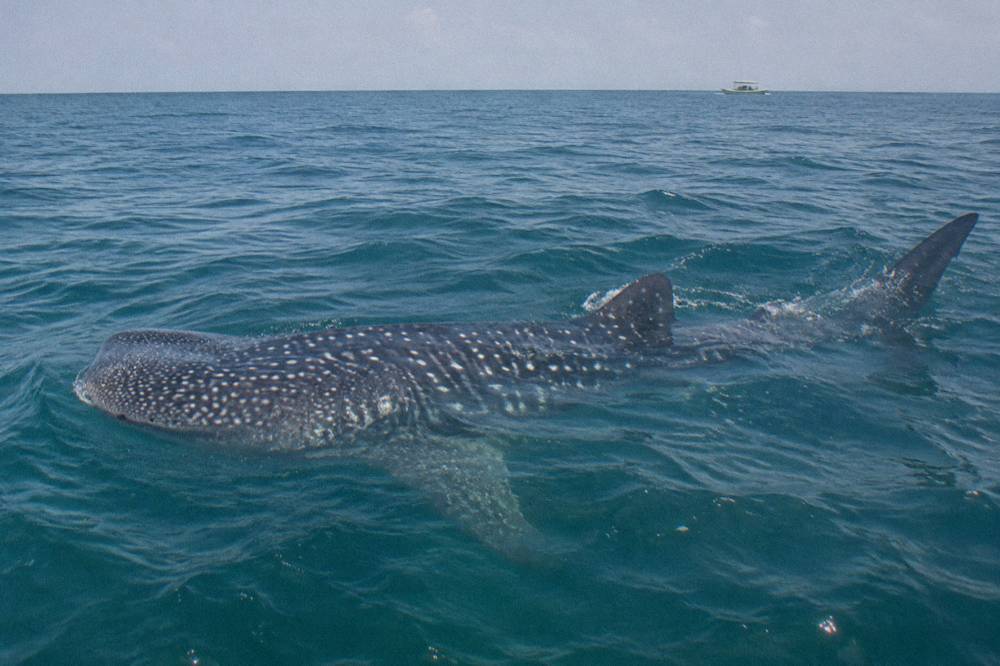
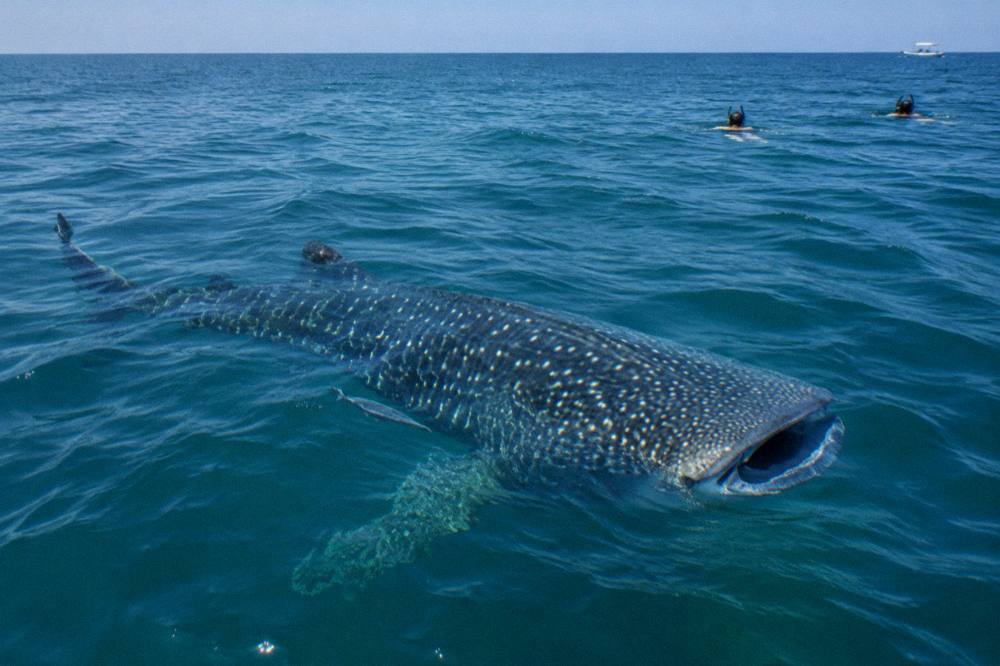
Distances sound generous on paper and feel short in the water. A whale shark's tail is several metres from its head, so staying 2 metres from the head and 3 metres from the tail still puts you close enough to see the spots, the gills and the filter-feeding mouth as the animal works past you. The rules do not make the encounter distant; they make it predictable, and a shark that is not harassed keeps swimming its line instead of diving.
Rule
What NOM-171 says
What it means in the water
Boat distance
Not closer than 5 metres to the shark
The boat shadows you; it never crowds the animal
Swimmer distance, head
2 metres to the side of the head
You swim level with the body, never at the mouth
Swimmer distance, tail
3 metres from the tail fin
The tail is large and moves fast; stay clear
Waiting boats
Held back, 50 metres or more
Other groups rotate in after yours finishes
Swim position
Never in front of the shark
You enter from the side so the path stays open
If you want a sense of how a real Holbox listing handles the practical side, the All-Inclusive Search and Swim listing from VIP Holbox Experience describes a real-time satellite tracker on board and a guide-supervised swim, from $209 per person for a 7-hour trip, rated 4.9 from 267 reviews. You can read the full breakdown on the All-Inclusive Holbox whale shark swim page before deciding.
Distances are set by NOM-171-SEMARNAT-2018 and apply nationwide.
How Does NOM-171 Control Boats And Time Around The Sharks?
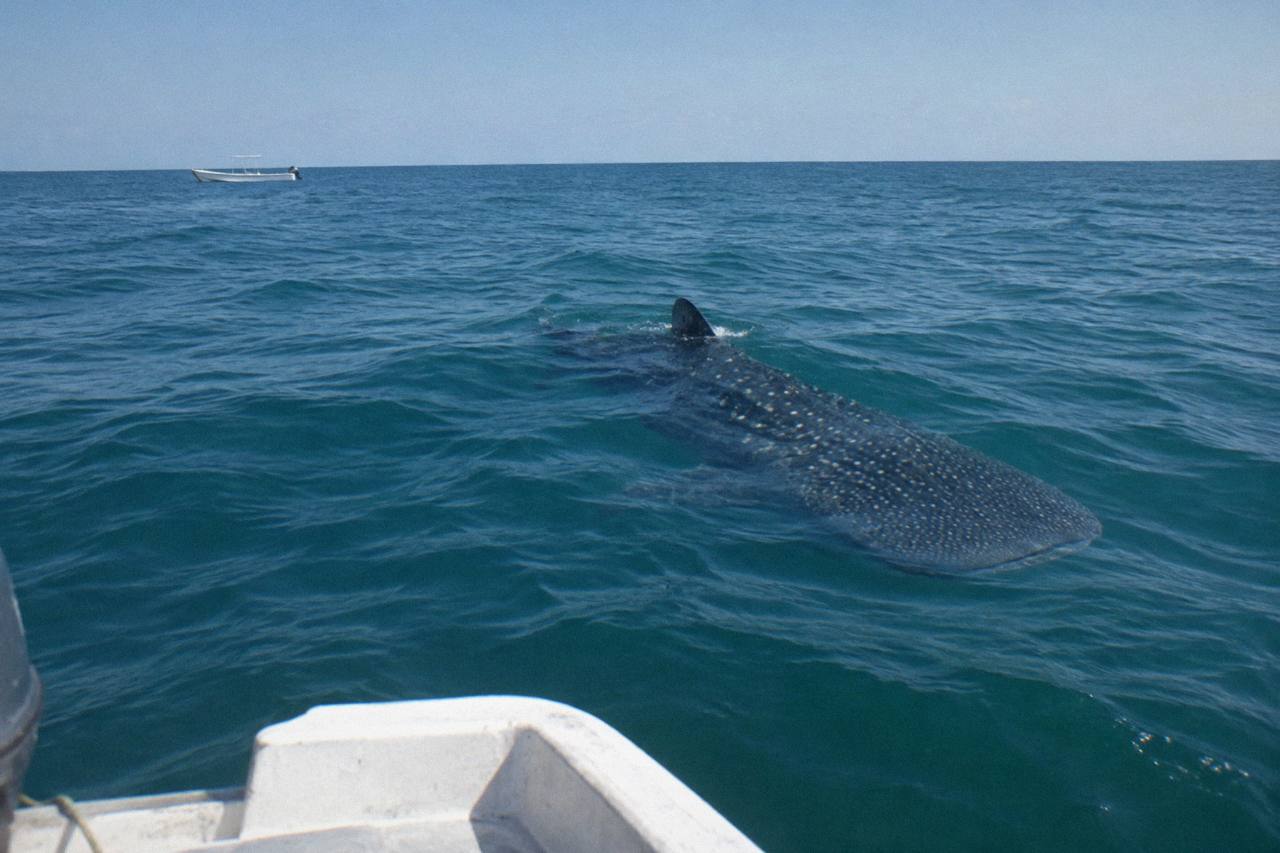
Only one authorised boat may be around a shark at a time, for a maximum of 30 minutes, after which it withdraws and the next boat takes its turn from 50 metres away. Boats are limited to 11 metres in length, must carry an identification pennant, and must slow to 3 knots inside aggregation zones and 7 knots near a shark.
The time-and-rotation system is the part of the rules you will feel most as a guest. When your boat reaches the aggregation area, it queues with the others; when your turn comes, your group swims in rotations while the guide manages the clock. Mid-season 2026, a Riviera Maya News report quoting the head of the Holbox tourism cooperatives described 15 to 20 boats going out daily at about half capacity, so in peak weeks of July and August the water around the shared feeding zone is genuinely busy, and the rotation is what keeps it orderly rather than chaotic.
Speed limits matter more than they sound. A boat engine at cruising speed is the main real hazard in this activity, which is why the norm caps speed near the animals and requires quiet water entry, no jumping and no back-flips from the boat. The vessel positions itself ahead of the shark at an angle, the guide counts the swimmers in, and the encounter happens at the shark's pace, not the boat's.
Control
Limit under NOM-171
Why it exists
Boats per shark
One at a time
Prevents the shark being surrounded
Time per boat
30 minutes maximum
Limits disturbance and keeps rotations moving
Waiting boats
Held back at a distance
No crowding while another group swims
Boat length
Up to 11 metres
Small vessels only inside the zones
Speed near a shark
7 knots
Engine noise and propeller risk
Speed in aggregation zones
3 knots
Feeding areas are shared and shallow
Boat authorisation is not automatic. For 2026, CONANP issued 146 permits across the three departure zones, split 92 to Isla Mujeres, 48 to Holbox and 6 to Chiquila across 14 cooperatives, per the same July 2026 report. An authorised boat flies an identification pennant, and CONANP and PROFEPA patrol the zones. If you want to go deeper on the ethics side of permits and practice, the article on whether a Holbox whale shark tour is ethical works through the arguments.
What Equipment And Sunscreen Rules Apply On A Holbox Swim?
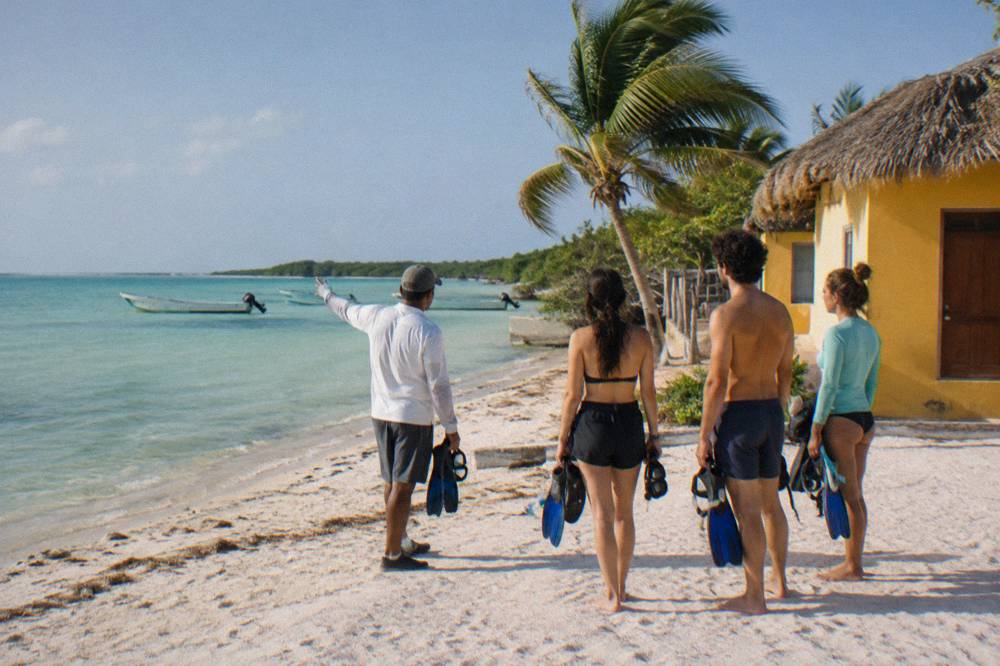
The standard requires swimmers to wear a life vest or wetsuit together with mask, fins and snorkel, and allows only biodegradable sunscreen or tanning products before entering the water. Water entry must be quiet: no jumping, no back-flips, and the boat positions itself ahead of the shark at an angle before the guide signals you in.
The sunscreen rule is the one guests break most often without meaning to. Conventional sunscreen washes off and, in a feeding aggregation, that matters, so the norm allows only biodegradable products, and many guides recommend a rash guard instead of any lotion at all. Put the sunscreen on before you leave the dock, reapply only what the rules allow, and pack the rest of the kit from the what to bring on a Holbox whale shark tour checklist.
Equipment is not optional even for confident swimmers. The life vest or wetsuit is a rule, not a suggestion, and it also does the practical work of keeping you level at the surface while the shark swims beneath and beside you. Fins help you hold position alongside an animal that moves faster than it looks. Every Holbox whale shark swim listing includes snorkel gear among its inclusions, which is worth confirming wherever you eventually book, because gear quality varies more than gear presence.
A listing that publishes its group limit, its gear list and its guide supervision up front has already answered half the vetting question. The 7-Hour Group Adventure from Holbox Whale Shark Tours, from $184 per person and rated 4.3 from 86 reviews, states a maximum of 10 travellers per booking group and lists government fees among its inclusions rather than leaving them to the dock. Check availability on the live listing and compare what it says against the conduct code above.
What Does A Responsible Whale Shark Operator In Holbox Do?
A responsible Holbox operator is authorised under the seasonal permit system, briefs guests on the NOM-171 conduct code before departure, keeps the boat at its distances, rotates swimmers with a guide in the water, allows only biodegradable sunscreen, and states plainly which fees are included and which are paid separately on the day.
You can test an operator with three questions before you pay anything. Ask how many travellers the boat carries, since Holbox listings state maxima of 8 or 10 per booking group and that figure shapes the whole day. Ask what fees are included, because some listings bundle government fees while others state a separate departure tax paid at check-in, and a listing that hides that split is telling you something. And ask about the swim briefing, because a guide who explains distances and rotations on the dock is a guide who follows them offshore.
Sign of a compliant operator
Where to check it
States a maximum group size of 8 or 10 travellers
The listing's group-size line
Lists snorkel gear, vest and guide among inclusions
The inclusions section
Says which fees are included and which are separate
The exclusions and fees section
Publishes free cancellation and a meeting point
The booking terms
Describes guide-supervised swim rotations
The listing description
Meets inside Holbox, not an unmarked dock
The meeting-point address
The three Holbox swim listings compared in the how to choose a Holbox whale shark tour guide all pass this test in different ways. The Eco Tour with Lunch from Xtreme Holbox, from $190 per person and rated 4.6 from 57 reviews, lists a certified guide in English, Spanish and French, hotel pickup within Holbox, life jackets and two supervised water entries per couple. It is a good example of a listing that answers the vetting questions before you ask them.
What Is Forbidden During A Whale Shark Swim In Mexico?
The standard prohibits touching, riding, harming, chasing or blocking a whale shark's path, swimming in front of it, and using flash, artificial light or a selfie stick. Photographs are allowed, but only in natural light, and no jet skis or small powered craft are permitted near the sharks.
Touching is the prohibition with teeth, legally as well as physically, and there is a fuller treatment of why in the post on why touching a whale shark is illegal. The short version: swimmers enter two at a time, each pair with their guide beside the shark. Riding or grabbing an animal that size is also how swimmers get hurt, not by any aggression on the shark's part. Whale sharks are filter feeders; the real risks in this activity are boats, crowds and seasickness, and every rule in NOM-171 is aimed at exactly those three.
The photography rules surprise people who have seen drone and flash clips online. No flash, no artificial light and no selfie sticks, full stop. Natural-light photos from a respectful distance turn out better anyway, because the shark swims its line and you simply hold position while it passes. Some operators sell photo packages taken by a crew member who knows the angles and the rules; boats out of Isla Mujeres sell GoPro files as an optional purchase, for example, and that is the compliant way to get the shot.
Prohibited
Allowed
Touching, riding or holding the shark
Swimming alongside at the set distances
Swimming in front of the shark
Entering from the side, behind the head
Flash or artificial light
Natural-light photos and video
Selfie sticks
Handheld cameras held close to your body
Chasing or blocking the animal's path
Floating and letting the shark pass
Feeding or dumping waste
Nothing introduced to the water at all
Enforcement is real rather than theoretical. CONANP and PROFEPA patrol the zones, compliance monitoring has included drones in published studies of the site, and an operator that breaks the conduct code risks the permit that lets it operate at all. That is the quiet protection built into booking an authorised listing: the operator has a reason to run the day by the book.
Where Do The Mexico Whale Shark Rules Apply?
NOM-171 applies nationwide, but the rules you will swim under on a Holbox trip come from its application in three protected areas: the Yum Balam reserve that wraps around Holbox and Chiquila, the Whale Shark Biosphere Reserve of about 146,000 hectares running from Isla Contoy to Bahía de la Ascensión, and the Caribe Mexicano Biosphere Reserve covering the Cancun and Isla Mujeres side.
What that means practically is that the same conduct code follows the sharks across the whole aggregation zone. A Holbox boat and an Isla Mujeres boat working the same feeding area hold the same distances, the same rotation and the same 30-minute clock. There is no softer rulebook on one side of the water. The differences between departure points are logistics: ride time, boat type and group size, all covered in the what to expect on a Holbox whale shark tour guide.
Yum Balam deserves a sentence of its own, because it is the reserve you actually enter from Holbox. Access carries a fee collected separately, and a July 2026 news report quotes about 230 pesos a visitor, from a cooperative representative, not an official tariff page. Some tour listings include fees and others state them as paid on the day, so read the exclusions line of whichever listing you book rather than assuming.
The one thing the rules cannot schedule is the sharks themselves. Sightings, water clarity and conditions vary, nothing about the encounter is guaranteed, and the season only runs while the notice says it does. Plan for next season from mid-May, weigh the listings against the conduct code above, and the rules will do their part of the work while your operator does the rest.
Common Questions About Swimming With Whale Sharks In Mexico
Is touching a whale shark illegal in Mexico?
Yes. NOM-171 prohibits touching, riding, harming, chasing or blocking a whale shark's path, and enforcement runs through CONANP and PROFEPA patrols in the protected areas.
What sunscreen can you wear swimming with whale sharks?
Only biodegradable sunscreen or tanning products are allowed before entering the water. Many guides recommend a rash guard instead of lotion, and conventional sunscreen should stay on the dock.
How many boats can be around one whale shark?
One authorised boat at a time, for a maximum of 30 minutes, with other boats waiting at a distance before taking their turn in rotation.
When is whale shark season in Holbox?
The 2026 season ran from 15 May to 17 September under the SEMARNAT notice, and it is now closed. Next season typically opens from mid-May once the new notice is published; most operators run roughly from the start of June to mid-September.