Three Islands, Pickup Included
3 hours 30 minutes
★ 4.5 · 217 reviews · From $39
Check availability →Holbox bioluminescence turns the shallow bays around Punta Cocos and Punta Mosquito into a faint blue glow on dark summer nights. It runs roughly May to October, peaks near the new moon, and is never guaranteed, which makes timing, tour choice and moon-phase planning matter more than anything else.
Short answer
Holbox bioluminescence is commonly described as visible May to October, strongest roughly July to September, and best on dark nights near the new moon. Two kayak listings cover it: a 2-hour stargazing paddle from $49 per person, and a 1 hour 45 minute tour from $47 per person with a maximum of 15 travelers. Neither can promise the glow.
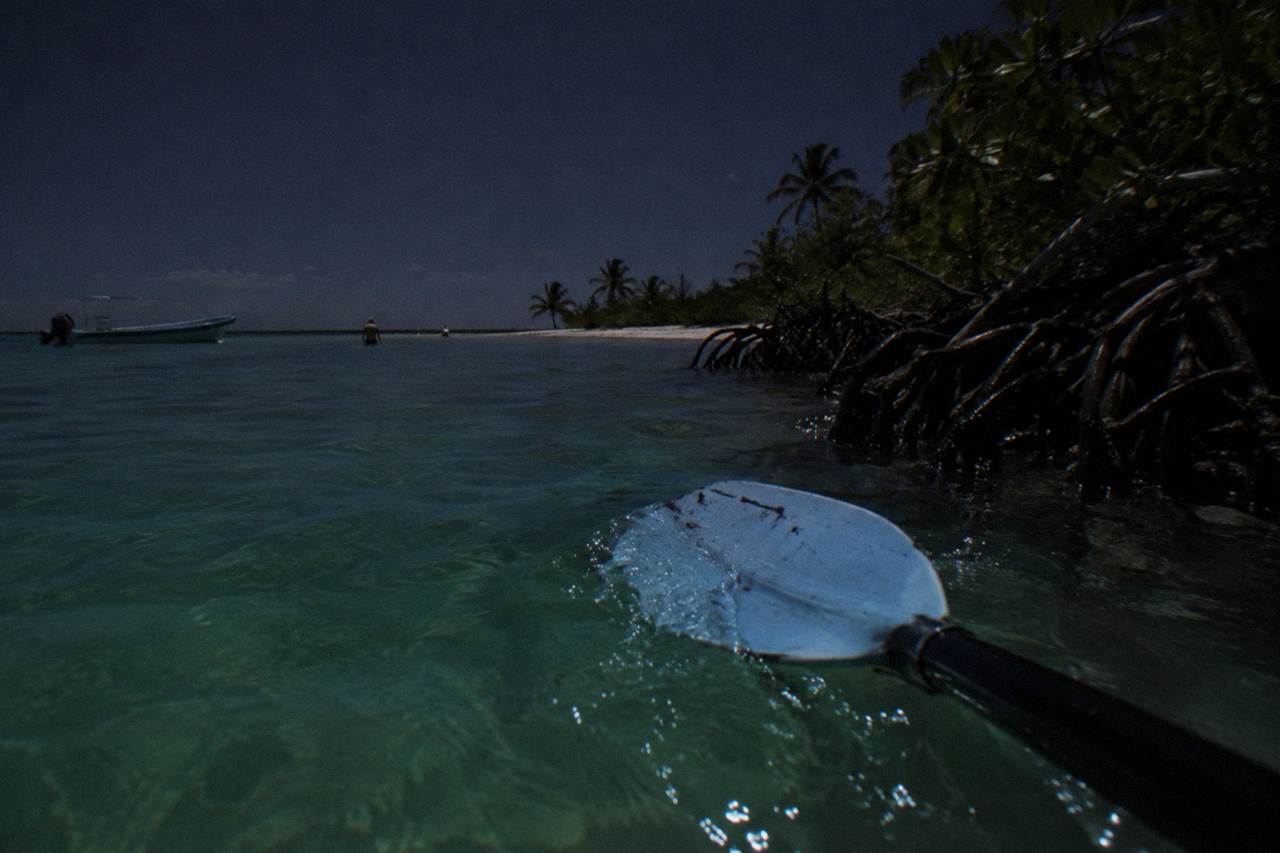
Bioluminescence in Holbox is a natural blue glow produced by tiny marine plankton that flash when the water around them is disturbed, whether by a paddle stroke, a footstep, or a passing fish. The effect appears best on shallow, calm, dark nights in the bays near Punta Cocos and Punta Mosquito, roughly between May and October, though intensity varies nightly with plankton concentration, wind, and rain.
The effect comes from dinoflagellates, microscopic organisms that live in warm coastal water and emit light as a defence reaction. When enough of them gather in a shallow bay, the water lights up along every moving edge: a kayak hull, an oar, a hand trailed in the sea. On Holbox the phenomenon is associated with the warmer months, when plankton concentrations rise, and it fades as the water cools toward winter. Local reporting on the island describes the phenomenon as running from May to October with the strongest displays in the height of summer, a pattern consistent across operator pages and Quintana Roo news coverage of the island's night tours.
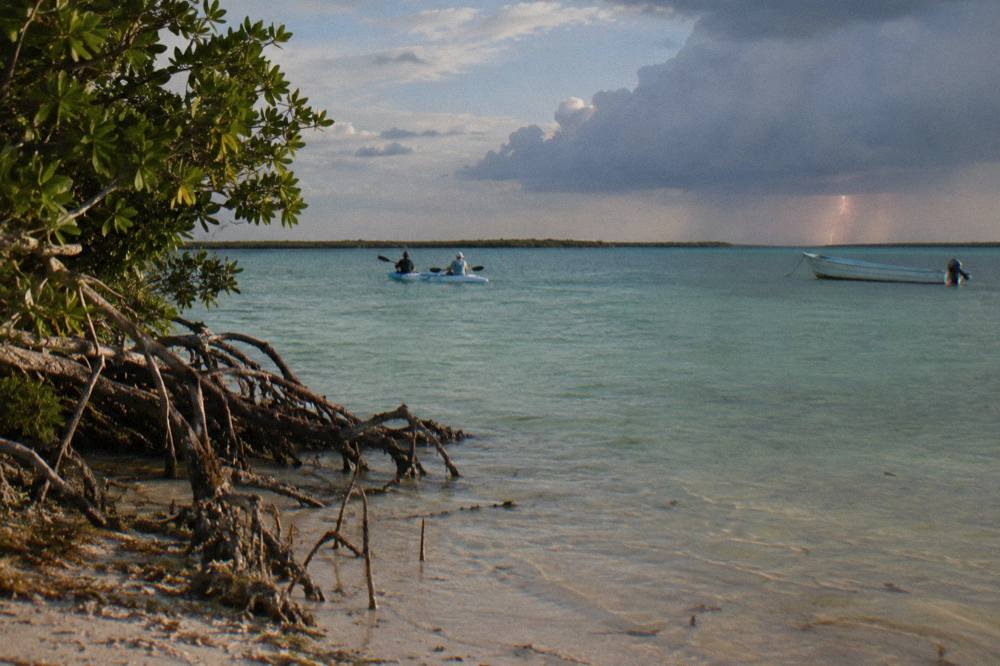
What makes Holbox a good stage for it is geography. The island sits on the Gulf-facing side of the Yucatan peninsula, inside the Yum Balam reserve, with wide, shallow, sandy flats at Punta Cocos and Punta Mosquito rather than deep open Caribbean water. Shallow bays warm quickly, concentrate plankton near shore, and are calm enough on quiet evenings for the glow to read clearly. The same dark-sky quiet that draws stargazers to the island's west end is what gives the bioluminescence a black backdrop to shine against.
It costs nothing to look for. Plenty of visitors simply walk or take a golf cart to a dark stretch of beach and wade. The paid kayak tours exist because the glow follows motion, and a moving kayak drags a ribbon of light behind it across a whole bay, which is a different experience from watching your own footprints. If you want the broader picture of the island's free and cheap options, see the things to do in Holbox guide.
The best months for Holbox bioluminescence are May through October, with the strongest glow roughly July to September. July and August pair peak plankton with sea temperatures of 28.9 to 29.4 degrees C, May and June bring the first displays as water warms, and September can still glow well, though blooms respond to wind, rain and freshwater runoff, so dark nights happen in any month of the window.
The month-by-month pattern tracks the sea. Satellite monthly averages for Holbox water temperature rise from 27.6 degrees C in May to a peak of 29.4 in August, then ease through 29.3 in September and 28.5 in October. Warmer water supports the plankton responsible for the glow, which is why late summer is described as the strongest period on the island. Quintana Roo news coverage and island operator pages agree on this July-to-September emphasis, while noting that the phenomenon is visible, off and on, across the whole May-to-October span.
| Month | Season status for the glow | Average sea temperature |
|---|---|---|
| May | Window opens, displays begin, inconsistent | 27.6 C |
| June | Building, more frequent on calm nights | 28.2 C |
| July | Strong period begins | 28.9 C |
| August | Typically the strongest month | 29.4 C |
| September | Still strong early, fading late, peak hurricane risk | 29.3 C |
| October | Fading, occasional late displays | 28.5 C |
Two timing notes are worth more than any calendar. First, the glow and the whale shark season overlap almost completely: the official 2026 whale shark window ran 15 May to 17 September, which means a July or August trip can plausibly pair a morning swim with a night paddle on the same day. Second, hurricane season runs 1 June to 30 November with the highest risk in September, and a storm system anywhere nearby stirs the water and kills the glow for days. Early October 2026 brought heavy rain that flooded Holbox streets, a reminder that late-window nights can be written off by weather. For the wider month-by-month picture of visiting the island, the best time to visit Holbox guide carries the full breakdown.

Two listings cover the night glow on Holbox. Eco Adventure Holbox runs a 2-hour Bioluminescence Kayaking and Stargazing tour from $49 per person, rated 4.6 from 360 reviews, with hotel pickup listed. Xtreme Holbox Island runs a 1 hour 45 minute kayak tour from $47 per person, rated 4.6 from 197 reviews, with hotel transport and all fees and taxes listed and a stated maximum of 15 travelers. Both list free cancellation.
The choice between them is mostly about shape, not quality. The Eco Adventure line adds stargazing to the paddle, includes a one-way transfer from your hotel, a 10-litre dry bag per couple, passenger insurance and drop-off at your hotel or the town centre, and runs about 2 hours. The Xtreme Holbox line is a touch shorter at 1 hour 45 minutes, includes private transport, kayak and snorkel equipment, all fees and taxes, and bottled water, and caps the group at 15 travelers per the listing. Neither listing promises the glow, and no operator can, since plankton cannot be booked.
| Listing | Card name | Duration | Price | Rating | Pickup | Notable inclusions |
|---|---|---|---|---|---|---|
| Eco Adventure Holbox | Bioluminescence Plus Stargazing | 2 hours | from $49 per person | 4.6 from 360 reviews | Hotel pickup listed | One-way hotel transfer, gear, insurance, dry bag per couple, certified guide, drop-off |
| Xtreme Holbox Island | Bioluminescence Kayak, 1 Hour 45 Minutes | 1 hour 45 minutes | from $47 per person | 4.6 from 197 reviews | Hotel pickup listed | Private transport, kayak and snorkel gear, all fees and taxes, water, max 15 travelers |
A note on fees, because the island has several. The Xtreme listing includes all fees and taxes in its price. The Eco Adventure exclusions line lists only gratuities, mosquito repellent and any taxi you request for shopping or ATM stops during pickup. Yum Balam reserve access is a separate matter on some Holbox boat products; a July 2026 news report quotes about 230 pesos a visitor, from a cooperative representative, not an official tariff page. For the kayak listings here, print nothing beyond what each listing states.
Meeting logistics are simple on a car-free island. Both tours pick up within Holbox or meet you at a central point, and the paddle launches from the beach rather than a marina. Wear clothes you do not mind getting damp, bring mosquito repellent for the mangrove edge, and leave the phone torch alone once the paddle starts, since white light wrecks both the glow and everyone's night vision. For what else earns space in a dry bag, the what to bring to Holbox packing guide covers the shared kit.
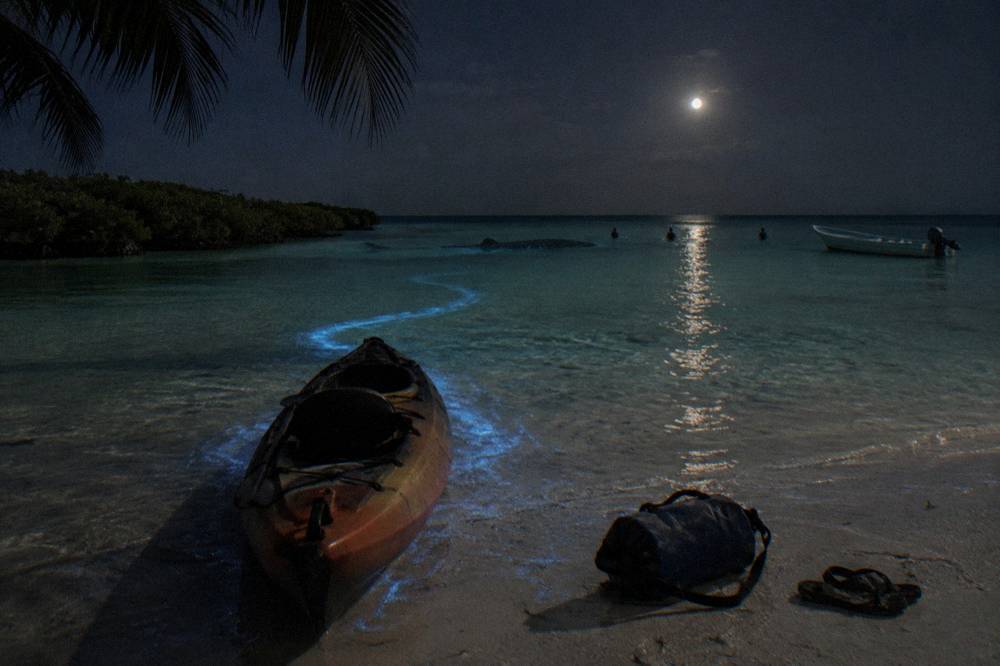
If the glow is your main reason to visit and you want a backup plan, booking the stargazing version makes sense: on a night the plankton stays dark, you still get a genuinely dark sky over the Yum Balam flats, which is its own reward.
Three Islands, Pickup Included
3 hours 30 minutes
★ 4.5 · 217 reviews · From $39
Check availability →The glow does not change with the moon, your ability to see it does. Bioluminescent plankton flashes just as brightly under a full moon, but the moonlight washes the pale blue sparks out of view, so tours on Holbox are scheduled around dark skies and cluster near the new moon. Around the full moon, even a strong display can be invisible from a kayak, which is why operators steer clear of those nights.
Think of it as signal against background. The light emitted by the plankton is faint, blue-white and close to the water surface. A dark sky gives a near-black background and the sparks read clearly; a waxing or full moon raises the background brightness until the human eye can no longer separate the two. Operators on the island plan departure calendars around the lunar cycle for exactly this reason, concentrating paddles in the roughly two weeks centered on the new moon and standing down around full-moon nights.
No specific moon-calendar dates belong in a planning article: the new moon shifts year to year, and tour calendars shift with it and with the weather. The practical move is to pick your travel dates first, then check where the lunar cycle falls, and if your dates land on bright nights, treat the paddle as a star-and-silence tour with a possible glow bonus. Guests who travel between the last quarter and first quarter moon, closest to the new moon, get the best odds. Island coverage of the phenomenon, including this Quintana Roo report on the best season for Holbox bioluminescence, makes the same point: warm months plus dark skies is the whole formula.
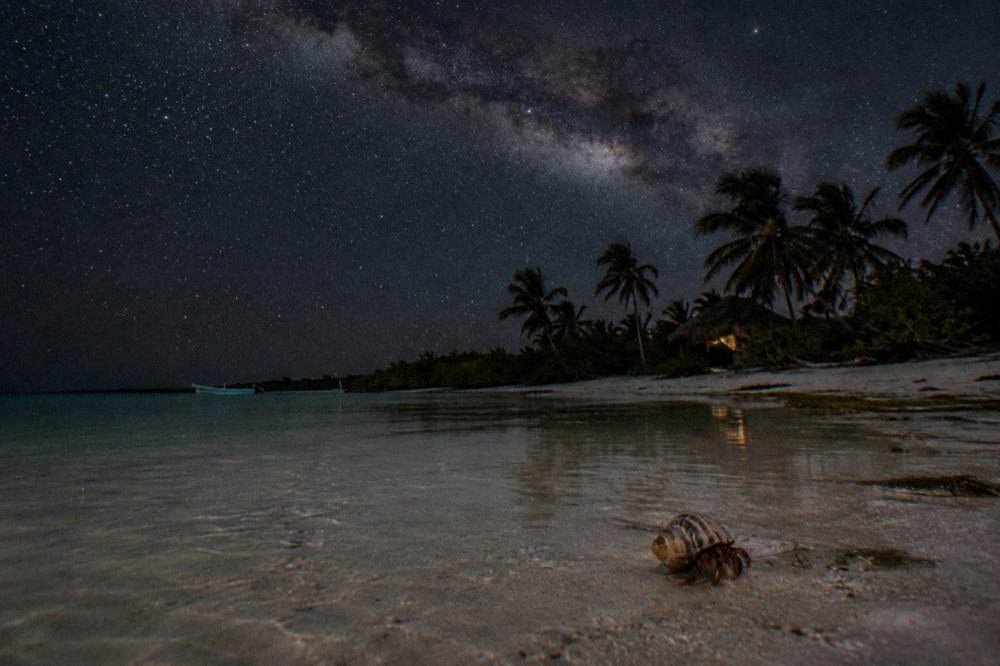
Because the glow is produced by living plankton whose numbers cannot be booked in advance. It depends on the concentration of organisms in the water on that exact night, along with calm conditions and low freshwater runoff, and all three vary independently of any calendar, so a bay that glowed on Saturday can be dark on Sunday, which is why every listing calls the phenomenon possible, never promised.
The physics is the easy part. Dinoflagellates flash when mechanically stimulated, which is why paddles, hulls and swimming fish all leave light. The biology is the hard part: the organisms bloom, drift, thin out and re-concentrate on timescales of days, driven by water temperature, nutrients, salinity and current. Heavy rain matters twice over, since freshwater runoff both dilutes the salt water the plankton prefers and clouds the shallows. Wind roughs the surface so the sparks scatter rather than pool.
This is why the two listings are worded the way they are. Both sell the paddle, the guide and the dark sky as certainties and the glow as the thing you are most likely to see in season. Both listings hold a 4.6 rating, though the stargazing version has drawn more reviews, 360 against 197, which is exactly what to expect. If a guarantee matters more to you than the experience, spend the evening differently; if a dark-sky paddle with a strong chance of blue sparks sounds good either way, the risk is easy to accept, especially with free cancellation listed on both tours.
Two practical hedges help. Book early in your stay, not your last night, so a dark or windy outing can be retried before you leave. And check the operator's rebooking habit at checkout: on this island, tours carry free cancellation, so a weathered-out night can be rebooked for another date or refunded in full, though the listing's own policy is the one that counts.
Yes, and the calendars overlap almost perfectly. The official whale shark season on the Quintana Roo Caribbean coast ran 15 May to 17 September 2026, and the bioluminescence window runs roughly May to October, so a single July or August day can hold both: a morning boat out to the feeding grounds and a night kayak off Punta Cocos. Whale shark boats leave Holbox early, commonly returning early to mid afternoon, which leaves a rest gap before a night paddle.
The rhythm works because the two tours sit at opposite ends of the day. Whale shark swims from Holbox are 6 to 7 hours by the listings, with early departures and early afternoon returns; a 2-hour kayak that pushes off after full dark slots in after dinner and a rest. Guests doing both in one day should plan food around it, drink more water than feels necessary, and treat the afternoon as recovery, since back-to-back sun, sea and exertion is the classic route to exhaustion and seasickness on the second outing. The how to choose a Holbox whale shark tour guide walks the morning side of that decision.
| Time of day | Activity | What it involves |
|---|---|---|
| Before dawn | Whale shark boat departs Holbox | 6 to 7 hour listing, breakfast and ceviche on most, swim rotations with a guide |
| Early to mid afternoon | Return, lunch, rest | Shade, hydration, nap |
| After dark | Bioluminescence kayak | 1 hour 45 minutes to 2 hours, pickup listed on both, dark-sky paddle |
For the morning slot, one Holbox departure illustrates the pairing well. VIP Holbox Experience's all-inclusive Search and Swim with Whale Sharks runs 7 hours from $209 per person, rated 4.9 from 267 reviews, with breakfast, ceviche, snorkel gear, a satellite tracker for security and English, Spanish and French guiding listed; Check availability on the live listing for your dates. The 2026 season has closed, so next season, typically from mid-May, is the window to plan for; prior-year season notices have appeared around May, and no 2027 notice is out yet.
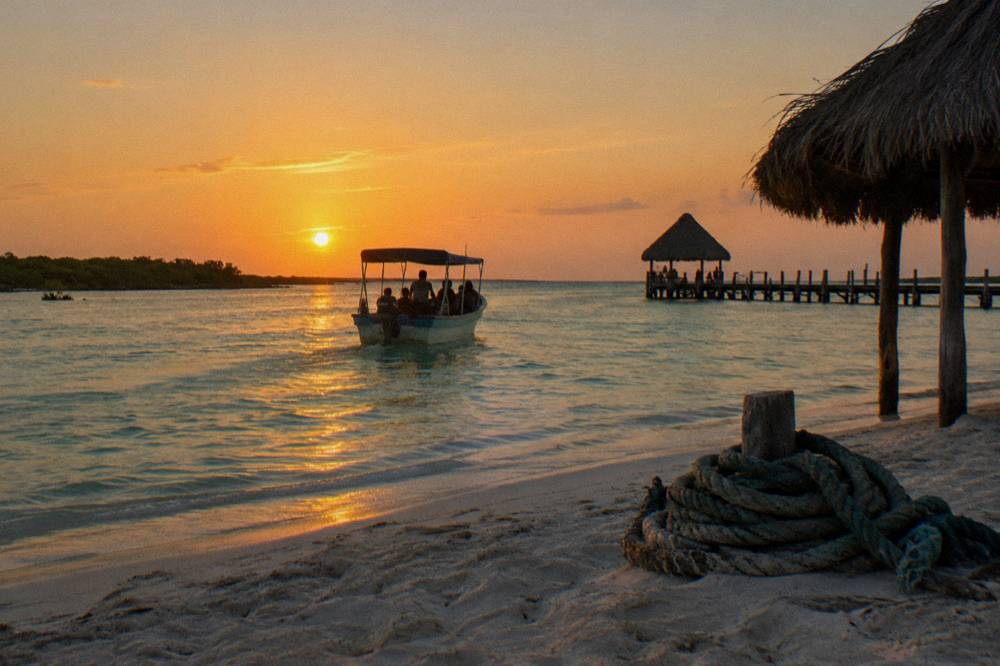
Other pairings work too. The island's daytime boat tours, from the three-island circuit to Cabo Catoche fishing trips, all finish by late afternoon, and the glow paddle is the natural evening complement. The Holbox whale shark tour combos guide collects the full set of pairings, and Holbox Island Whale Shark Tours lays out the morning swim listings side by side on the homepage comparison.
Wear a swimsuit or quick-dry shorts, a light long-sleeved top against mosquitoes, and sandals you can walk a dark beach in, and bring repellent, a towel, a dry bag if you have one, water, and little else, since anything not waterproof will get damp. Apply repellent before you launch, skip the torch, and keep the phone packed away, because white light and screens destroy the night vision the whole tour depends on.
Mosquitoes are the one near-certainty on a warm, windless night near the mangroves, and a windless night is exactly the night the glow reads best, so the repellent is not optional. The Eco Adventure listing names repellent in its exclusions, meaning you bring your own. Both listings provide life jackets and kayak equipment; the Xtreme line adds snorkel gear and bottled water, the Eco Adventure line a dry bag per couple; bring your own water. Neither lists a meal, so eat before pickup.
Footwear deserves a sentence. You will wade to launch on sand that may hold shells or the odd bit of sargassum wrack, and you will walk back off the same beach in the dark. Flat, secure, water-friendly shoes beat flip-flops. On the light question: a red-light headlamp if you own one is tolerated by most guides, but ask first rather than assuming, and never point any light at the water during the paddle.
Head for Punta Cocos and Punta Mosquito, the shallow flats at Holbox's west and east ends, both reachable from town on foot, by bike or by golf cart. Tours launch straight from the beach rather than a fixed marina, your guide picks the exact stretch each night based on wind, recent glow reports and group ability, and any dark stretch of shoreline away from the town lights can sparkle in season.
Punta Cocos, at the island's western tip, is the classic spot: a long shallow bay, a short cart or bike ride from the centre, and famous equally for its sunsets and its dark-sky nights. Punta Mosquito, the sandbar to the east, needs more travel and shallower conditions but rewards with a wider flat where every wake reads as light. Both are natural places, not managed sites, so there is no entrance gate and no fee to walk the beach yourself, only the reserve context of Yum Balam that applies to the island as a whole.
If you go independently, apply everything above with extra weight: dark night near the new moon, calm wind, a red or absent torch, and no expectation. Give your eyes ten full minutes to adjust, then watch the shallows where small fish stir. On a good August night the shore itself glitters as each wave breaks. On a poor night you get stars, warm air and an empty beach, which on this island is not a bad floor under any plan.
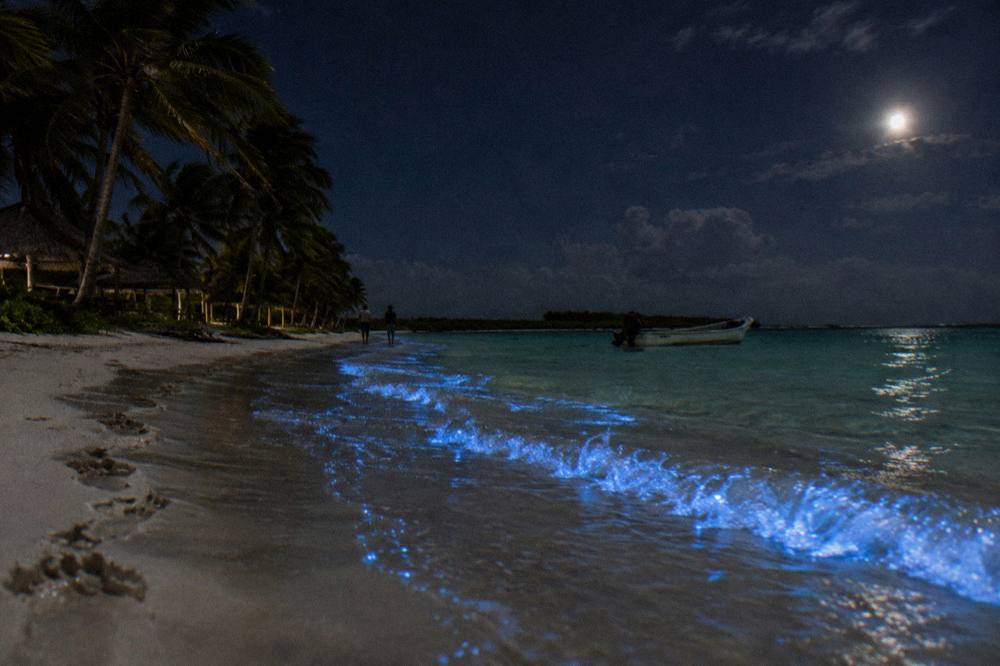
Aside from moon phase and month, the sea state matters more than most visitors expect. The satellite monthly sea temperatures Holbox visitors often check for the whale shark season, published by seatemperature.info for Holbox, are the same warm months the glow favours, but a choppy evening ruins visibility of the plankton even in August. Calm, warm and dark is the trifecta; you control only the darkness, by picking your dates.
For the full planning picture around the island's summer conditions, including the sargassum situation that local reports describe as relatively kind to Holbox in 2026, the Holbox sargassum report carries the detail.
A Holbox summer can hold both: whale sharks in the daylight hours, then a kayak out over glowing shallows once the sky darkens, timed to a moonless night.
No. The glow depends on plankton concentration, calm water and low freshwater runoff on the exact night, all of which vary. Every listing describes it as possible rather than promised, so treat a booked paddle as a dark-sky kayak with a strong chance of glow in season.
Two listings cover it: a 2-hour stargazing version from $49 per person and a 1 hour 45 minute version from $47 per person with a stated maximum of 15 travelers. Both list hotel pickup within Holbox and free cancellation.
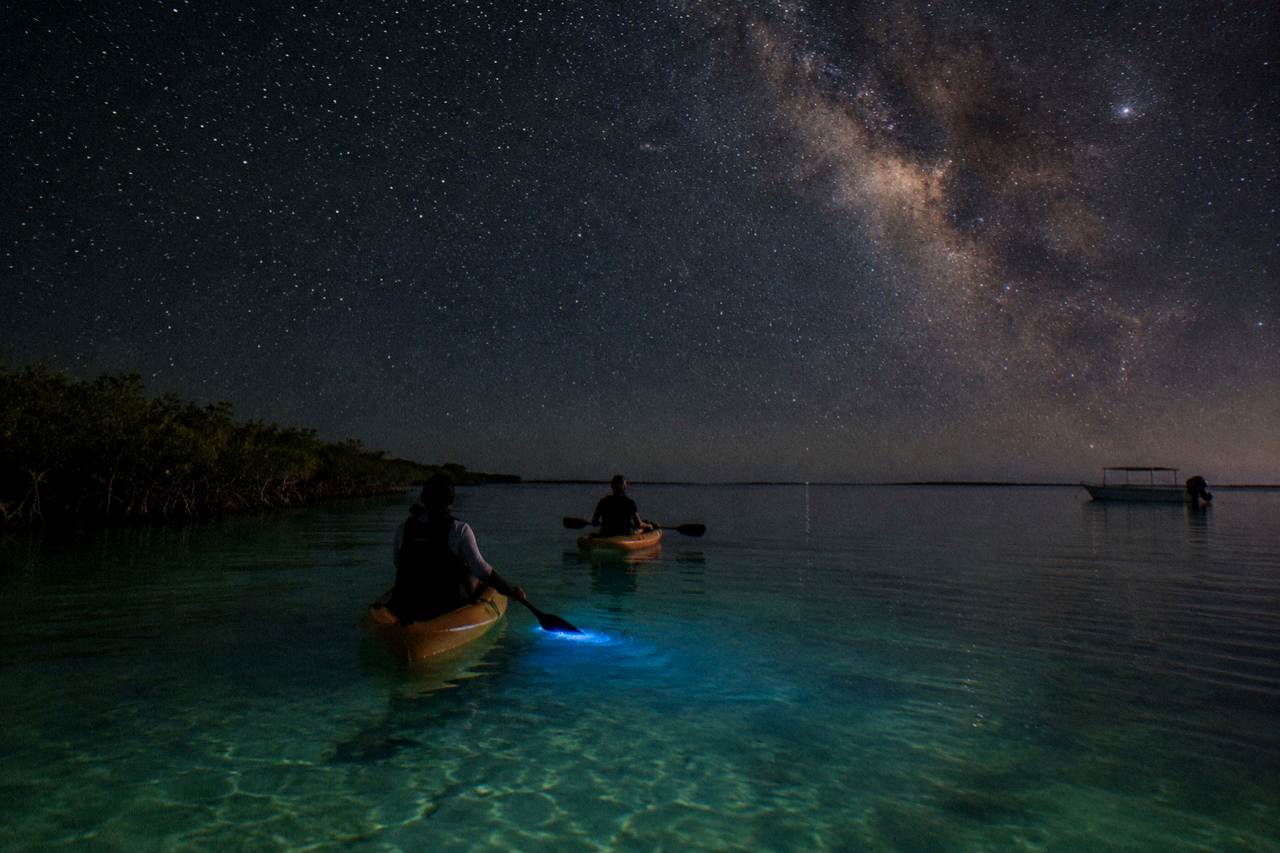
Before you go, the pick for this guide:
Bioluminescence Plus Stargazing
★ 4.6 360 reviews · From $49
Check availability →