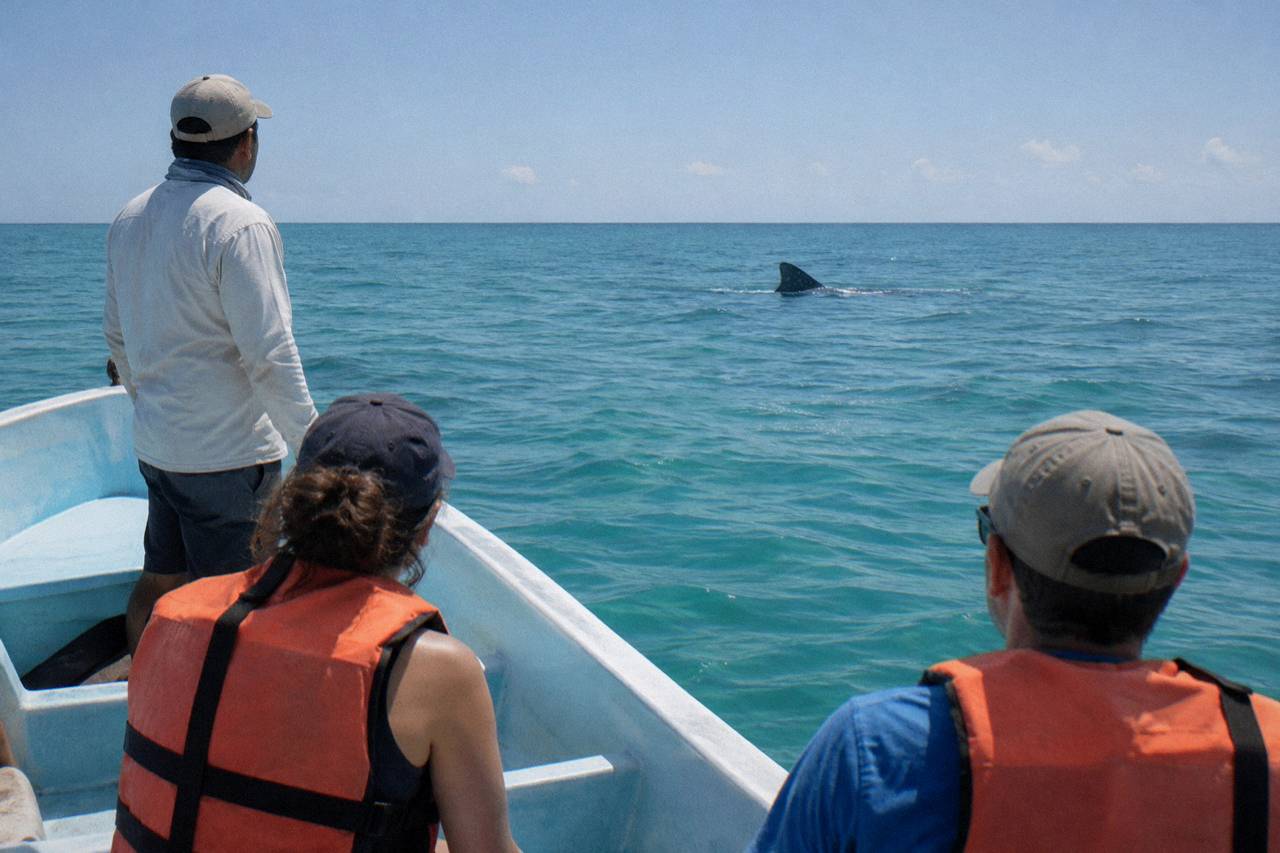
Is It Safe To Swim With Whale Sharks?
A clear-eyed look at whale shark swim safety from Holbox: filter feeder biology, NOM-171 rules, and what actually causes problems on tour, which is rarely the shark.
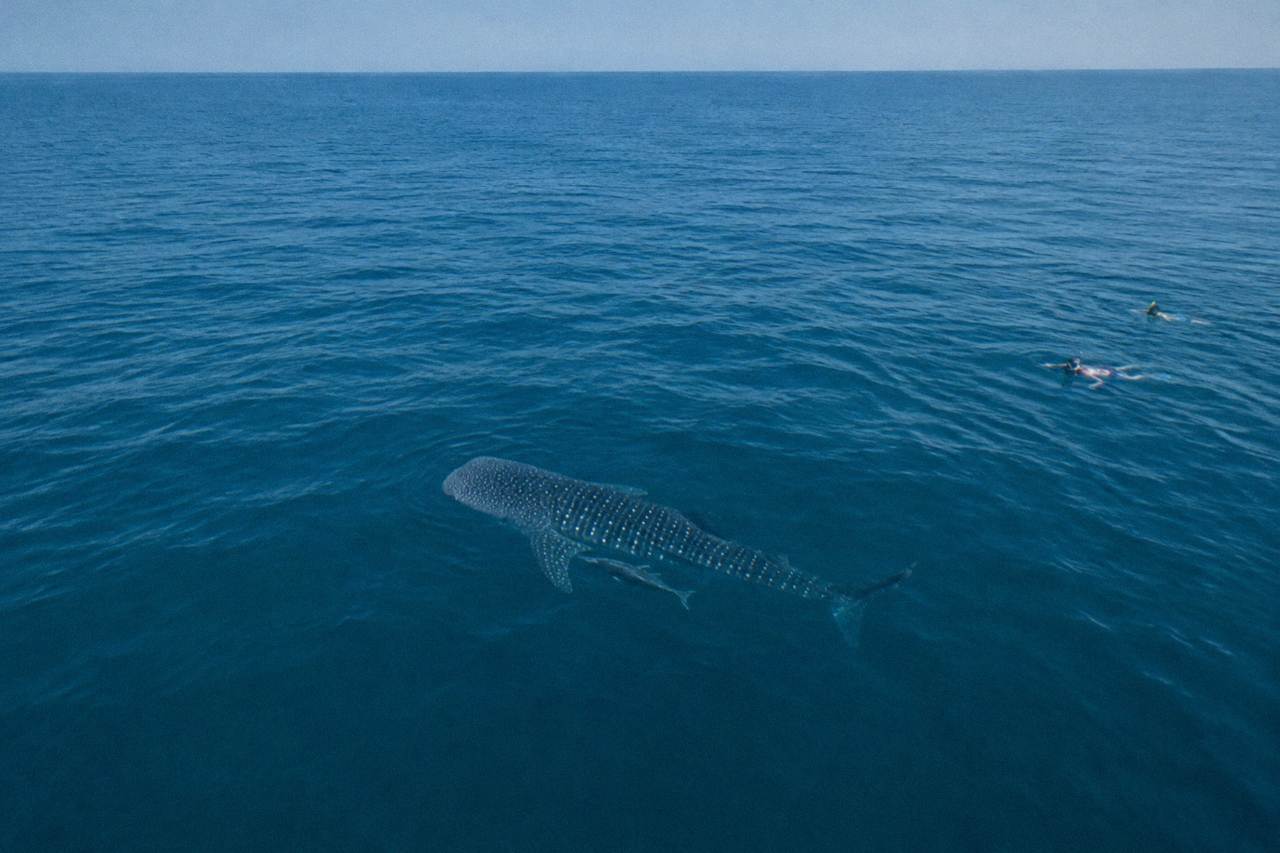
Whale sharks are the largest fish in the sea, and the question almost every first-time visitor to Holbox asks is not whether they will see one. It is whether getting in the water beside something the length of a bus is a sensible thing to do. The 2026 season closed on 17 September under the official SEMARNAT notice, so every swim now on the calendar is a next-season plan, typically from mid-May. That gives nervous swimmers a full winter to get comfortable with the facts, and the facts are reassuring in an unspectacular way: the animal is a filter feeder, the activity is governed by one of the more detailed wildlife tourism rules in the Americas, and the things that actually go wrong on these trips are boats, crowds and seasickness, in roughly that order. If the animal itself is still the worry, the whale shark attack record answers that question directly.
Yes, swimming with whale sharks is safe in the way that matters most: no whale shark attack on a swimmer appears in the reporting reviewed, the species feeds on plankton and small nekton, and Mexican federal rules require a specialised guide, a life vest or wetsuit, and fixed distances in the water. The real risks are human ones, like open-water swell, crowded boats in peak weeks, and motion sickness on the ride out. That mandatory life vest also answers the question nervous swimmers ask next: what swimming ability you actually need for a Holbox whale shark tour.
The biological point comes first because it dissolves most of the fear. Whale sharks are filter feeders. They swim forward with their mouths open and strain plankton, fish eggs and small organisms from the water column. They have no predatory interest in people, no teeth capable of biting a swimmer in any meaningful sense, and a documented behaviour pattern around boats and swimmers that is best described as indifference. The safety framing used by every serious operator and by the federal standard itself is not "dangerous animal, managed". It is "wild animal in a protected area, managed". That distinction shapes the entire rulebook.
The management side is where Mexico stands out. Whale shark observation and swimming are regulated nationwide by NOM-171-SEMARNAT-2018, a federal standard published in the Diario Oficial de la Federación that sets boat lengths, approach speeds, swimmer distances, guide supervision and prohibited conduct in exact terms. The current text is on the official DOF page for the standard. When people ask whether the activity is safe, the structural answer is that it is one of the few wildlife swims on earth where the law has already worked through the accident scenarios and written them out of the itinerary, boat by boat and swimmer by swimmer.
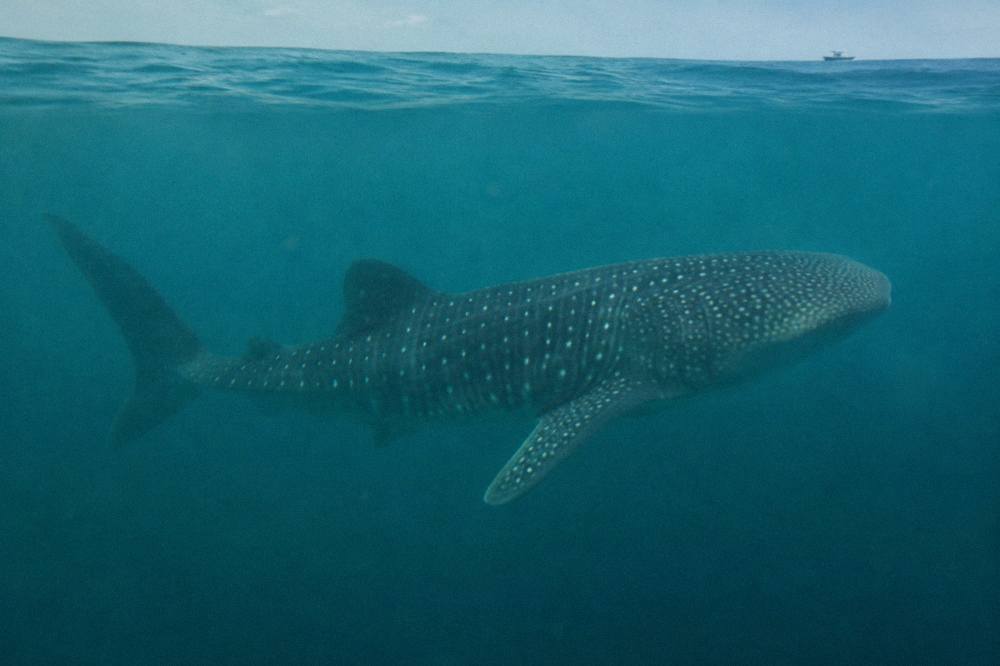
That legal scaffolding only protects you if your operator actually holds a permit, so the single most consequential safety decision you make is the booking, not the swim. On Holbox the permitted fleet is small: CONANP authorized 146 whale shark permits for the 2026 season across the region, split 92 to Isla Mujeres, 48 to Holbox and 6 to Chiquila across 14 cooperatives, per a July 2026 news report quoting the Holbox tourism cooperatives. Every authorized boat carries an identification pennant required by the standard. If the boat you are standing on has no pennant and the crew cannot name the rules below, you have found the one genuine hazard of the day.
For swimmers who want the safety picture built into the booking, three Holbox departures cover the range most travellers need: a supervised eco-tour format, an all-inclusive with the largest review pool, and a hotel-pickup option.
The first of those, the Eco Tour with Lunch, is a good fit for nervous swimmers: the listing states a maximum of 8 travelers, a certified bilingual guide, and two water entries per couple always under guide supervision, with hotel pickup within Holbox included from $190 per person. Check availability
What Actually Goes Wrong On Whale Shark Tours?
Three things, consistently: seasickness on the open-water crossing, crowding when many boats converge on the aggregation zone in July and August, and rough surface conditions that can cut a day short. Incidents involving the shark itself are effectively absent from the record. Operators and regulators plan for the first three and barely mention the fourth, which tells you where the risk actually lives. It lives on the boat, not in the water.
Start with seasickness because it is the most common bad experience by a wide margin. The Afuera aggregation zone where Holbox boats swim with whale sharks sits roughly 10 km offshore, and the ride out varies with where the sharks are feeding depending on where the sharks are feeding and the day's conditions. That is a long stretch of open water in a small lancha, and swimmers who have never been queasy in their lives regularly are. The standard advice is ordinary advice: take motion sickness medication the night before and again before boarding, stay on deck rather than in the bow, eat the light breakfast the tours provide rather than skipping it, and look at the horizon. If you know you are a hard case, prepare the way you would for any boat day.
Crowding is the second real issue. In peak weeks, mid-season news reported 15 to 20 boats a day working the Holbox zone at about half the fleet's capacity, and the federal rules exist precisely because the water can get busy. The standard allows only one boat at a time around a given shark for a maximum of 30 minutes, with other vessels waiting 50 metres away, and those rotation rules are what keep a crowded zone orderly rather than chaotic. Your experience of "crowded" will depend heavily on the operator's boat size and group discipline: small shared Holbox boats carry 8 or 10 travelers, while some larger Cancun departures take up to 20.
The third factor is weather, and it interacts with the calendar. Hurricane season runs 1 June to 30 November with the highest risk in September, the same month the swim season closes. Operators cancel or reschedule when conditions are poor, and a cancellation is the system working, not failing. Nobody swims in a swell that makes supervision difficult. That is also why the month-by-month season guide matters for planning: July and August are the peak months for sharks and for calm summer seas, while late-season trips trade thinner crowds for choppier weather odds.
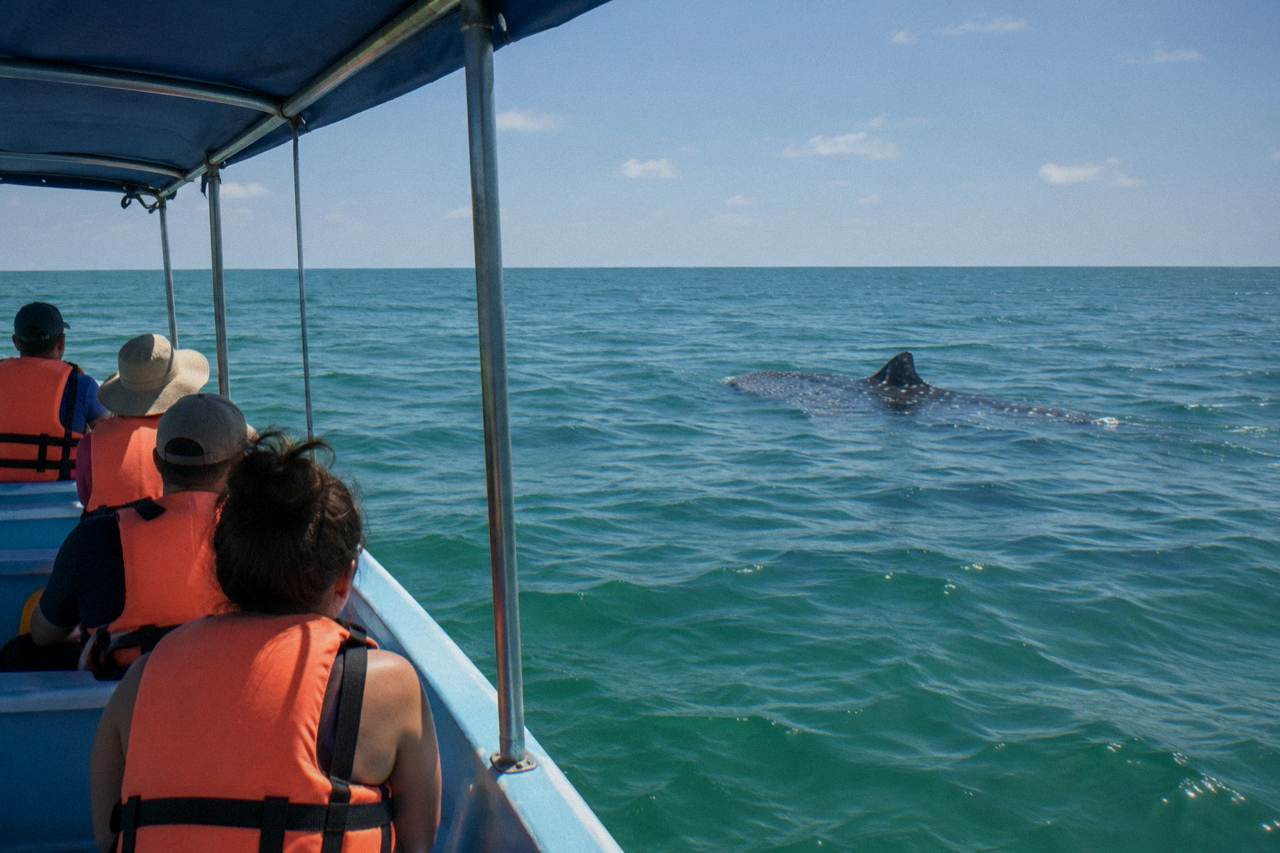
7 hours
★ 4.3 · 86 reviews · From $184
Whale shark swims ended for 2026 on 17 September. The 2027 season dates have not been announced, so open calendars may stay blank for now.
Check availability →What Rules Keep Swimmers And Sharks Apart?
Mexico's NOM-171 standard sets hard distances: boats stay at least 5 metres from a shark, while swimmers and guides keep 2 metres from the head and 3 metres from the tail. Each boat gets a maximum of 30 minutes with one animal while others wait 50 metres back, and swimmers slip in quietly from a boat ahead of the shark, never touching, riding, chasing, blocking its path, or swimming in front of it.
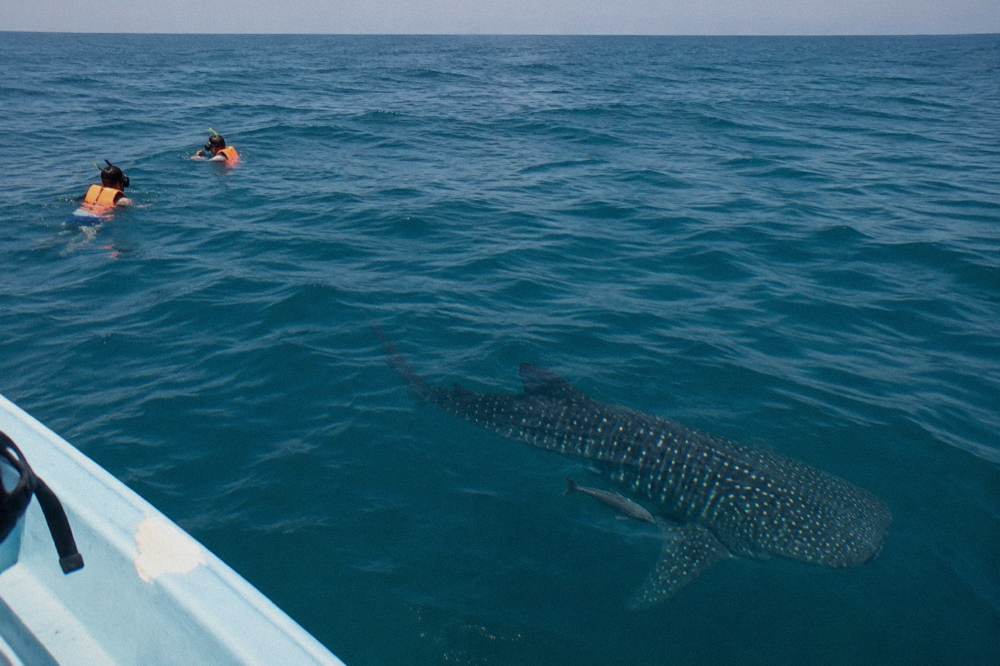
Those numbers are worth reading twice because they do the real safety work. A filter feeder that filters tons of water while swimming forward has a moving body that can injure a careless swimmer by simple physics, the way any large moving object can, and the 2 and 3 metre buffers exist to keep you out of its path rather than away from its intentions. The entry protocol is the same idea: the boat sits about 15 metres ahead of the approaching shark at roughly 45 degrees, and swimmers slip in quietly, because a swimmer dropping into the water directly above or in front of the animal is the one configuration the rules are built to prevent.
Equipment rules are equally specific. The standard requires mask, fins and snorkel, plus a life vest or wetsuit, and it permits only biodegradable sunscreen before entering the water. Photography is allowed but flash, artificial light and selfie sticks are not. Each authorized boat flies an identification pennant, vessels are limited to 11 metres, and approach speeds are capped near the animals. A specialised guide stays with a small group of swimmers in the water and keeps the group together; the exact swimmer-to-guide limit is set by each protected area's management programme, and operators differ in how they run rotations, so ask your operator how they structure the water entries rather than expecting one universal number.
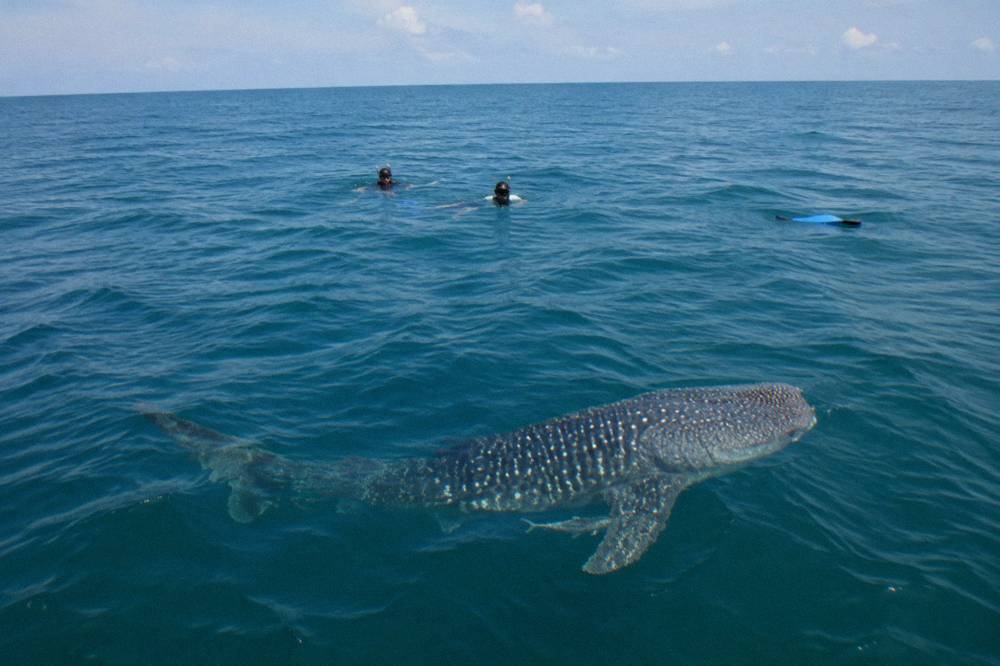
The rule against touching deserves its own sentence because it is the one with legal teeth. Touching, harming, riding or harassing a whale shark is prohibited conduct under the federal standard, and the subject is covered in more depth in why touching a whale shark is illegal. For the safety question the practical point is simpler: the rules constrain the humans, not the shark. The distance and entry rules exist for one reason: to keep swimmers out of the animal's path., which is why operators brief the code of conduct before the boat leaves the dock and why licensed crews repeat it at the swim ladder.
One reasonable worry people rarely say out loud: what if the shark turns toward me? The rules have already answered it. Swimmers keep to the sides, the guide tracks the animal's line, and the standard's requirement that no one swim in front of the shark means the animal always has open water ahead of it. A whale shark that decides to change course simply does, and the correct response, drilled into every briefing, is to let it. Guests on the better-run Holbox departures consistently describe the same sequence: a few seconds of awe-adjacent panic, then the realisation that the animal is utterly unbothered by your presence.
The all-inclusive option is a good example of safety details stated up front: the operator's page lists a real-time satellite tracker for security, a guide in the water with swimmers, and snorkel gear, with free cancellation listed and a 4.9 rating from 267 reviews, the largest review pool of any Holbox departure.
Are Whale Sharks Dangerous To Humans?
No recorded whale shark attack on a human exists, anywhere, ever. The species has no predatory role involving people: it feeds on plankton and small organisms filtered from surface water. The reported risks in this activity are boats, crowding and sea conditions. That is not the same as "no risk", and no guide or operator will claim otherwise, but the animal itself is not on the risk register.
The distinction between "safe animal" and "safe activity" is the whole article in miniature. Feeding ecology is the foundation: a filter feeder measuring up to a dozen metres is a moving wall of muscle, and the NOM's distance rules treat it with the respect owed to any large wild animal, while the attack record treats it, accurately, as a creature with no history of harming swimmers. The pattern holds across every aggregation site in the world, from Australia to the Philippines to the Mexican Caribbean. For readers who want the rarity angle quantified, how rare is it to see a whale shark covers the encounter side. The broader safety picture across operators appears in a dedicated safety guide.
It helps to know what the swim actually feels like, because fear thrives on vagueness. The typical Holbox format is a rotation: the boat tracks the animal, the guide positions swimmers in the water, and each swimmer gets a sustained stretch in the water beside the shark before the boat repositions for the next entry. Operators describe many sharks in peak weeks of July and August, with numbers building through June and fading in September, so in a good week the rotation runs more than once. The water entries are brief moments of floating and gentle finning, which is one reason a basic comfort in the water, not elite fitness, is the real prerequisite.
Non-swimmers and weak swimmers ask a fair question here: do you have to swim at all? You need to be able to move confidently in deep water with a vest on, and the do you need to swim to join question is worth reading before booking. Children's participation is a similar case-by-case matter, since minimum ages vary by listing and three Holbox listings bar children under 6 and the rest do not state one; the listing, not the operator's reputation, is the document to check.
Which Holbox Tours Handle Safety Best?
Look for four things in a listing: a stated traveler maximum, a certified guide supervising water entries, snorkel gear and life vests included, and free cancellation, the standard across Holbox whale shark departures. The Holbox swims compared below, at from $178 to $210 per person, with the private option from $1,246 per group for families who want the boat to themselves.
The comparison that matters for safety is not marketing copy but stated limits and supervision language, so here are the Holbox whale shark departures side by side on exactly those points.
| Listing | Operator | Traveler maximum | Water supervision stated | Price basis |
|---|---|---|---|---|
| Eco Tour with Lunch | Xtreme Holbox | 8 | Two entries per couple, always with guide supervision | from $190 per person |
| Search and Swim, All Inclusive | VIP Holbox Experience | not stated | Guide listed, satellite tracker listed | from $209 per person |
| Hotel Pickup, 6 Hours | Holtours SA de CV | 8 | Local guide listed | from $210 per person |
| 6-Hour Swim, VIP Holbox Experience | VIP Holbox Experience | 10 | Snorkel gear listed | from $178 per person |
| 7-Hour Group Adventure | Holbox Whale Shark Tours | 10 | Bilingual guide listed | from $184 per person |
| Private Swim, 7 Hours | VIP Holbox Experience | private, your group only | Bilingual guide listed | from $1,246 per group |
Read that table as a shortlist rather than a ranking. The smallest stated group caps are 8, shared by the eco-tour and the hotel-pickup listing, and smaller boats are the closest thing to a comfort multiplier this activity has: fewer people rotating through the water means more time beside the shark and a calmer deck between entries. The private listing removes the rotation question entirely, at a price per group rather than per person. None of the shared listings includes hotel pickup except where stated: the eco-tour and the hotel-pickup listing list it, while the two VIP Holbox shared boats meet at the yellow Mayan house office on Calle Palomino, so factor the taxi ride into a morning that starts before 7 a.m.
Fees deserve one clear paragraph because surprise costs feel unsafe even when they are not dangerous. Several listings state that a government, park or conservation fee is paid separately on the day, with the amount on the listing, and the hotel-pickup listing states a departure tax payable at tour check-in that its price does not include. None of this is a scam; it is how the protected-area funding works. Read the exclusions line on your listing before you go and bring cash, because Holbox Island Whale Shark Tours consistently reminds readers that the island's ATMs are scarce, cards can carry a surcharge, and small boats and fee windows run on pesos.
Preparation closes the last gap. The packing list is short and unglamorous: biodegradable sunscreen only, applied before boarding, a rash guard for long stretches in the water, motion sickness tablets taken on schedule, cash for fees and tips, and reef-safe expectations about visibility, which varies with plankton and weather and is not something any operator can promise. The full kit is itemised in what to bring on a Holbox whale shark tour.
The hotel-pickup listing above suits swimmers who want one fewer moving part on a nervous morning: pickup is within Holbox, the listing states a maximum of 8 travelers, and it carries a 4.5 rating from 47 reviews with free cancellation listed.
What Should An Anxious Swimmer Do Differently?
Choose a small-boat listing with guide supervision stated, book inside the July to August peak so the odds of a calm, successful day are highest, medicate for seasickness properly, and ask the operator two questions before booking: how they run the swimmer rotations, and what happens if no whale sharks appear, since refund terms vary by listing. Anxiety on this trip responds to specifics, and every one of those has a concrete answer.
The rotation question matters because it is where your actual time in the water is decided. Ask how long each swimmer gets beside the shark, how many entries per person, and whether the guide stays in the water with the group. Operators with clear answers to those three questions are, almost without exception, the ones running compliant boats. The refund question matters because a no-sighting day is possible on any departure: whale sharks are wild animals and no listing guarantees one, so check what the listing promises, some offer a repeat trip or partial terms, and treat any outright sighting guarantee as a red flag rather than a selling point. The what if there are no whale sharks question is covered in full elsewhere.
Timing your booking is the anxiety fix people underestimate. The official season typically opens in mid-May and closes in mid-September, with the 2026 window having run 15 May to 17 September per the SEMARNAT notice, and prior notices appearing around May each year, so the 2027 dates are not yet announced. Numbers build through June, peak in July and August, and fade in September. Sea temperatures tell the same story: satellite averages show 27.6 degrees C in May warming to 29.4 in August, the warmest month, before easing to 29.3 in September. An anxious swimmer wants the week where calm water and feeding sharks overlap, and that is mid-July to mid-August, accepting that those weeks also carry the most boats and that July and August mark the peak demand for good reason.
The last word on safety belongs to the pattern rather than the rules. Swims have now taken place under the NOM framework across the Mexican Caribbean, and the failure modes that fill incident reports are sunburn, queasy stomachs and bruised expectations on slow days. The animal that makes the trip worth taking has never once made the report. Book a permitted boat, respect the distances, keep your vest on, and give the boat ride the respect it is actually owed, and the safest part of your Holbox holiday will be the five minutes you spend beside the biggest fish in the sea.
Three Holbox departures come up most often for safety-conscious swimmers, and all three list free cancellation.
Common Questions About Whale Shark Swim Safety
Has a whale shark ever hurt a person?
No predatory attack by a whale shark on a human has been recorded anywhere. The animal feeds on plankton and small organisms filtered from the water. Injuries in this activity, where they occur at all, trace to people breaking distance or entry rules around a large moving animal, which is exactly what the federal standard's buffers and quiet-entry protocol prevent.
Do you have to be a strong swimmer?
You need confident movement in deep water with a life vest on, not athletic fitness. Swimmers enter in small supervised groups, swim hard for short stretches beside the shark, and return to the boat between rotations. If deep water worries you, read the listing's supervision language and ask the operator how rotations run before booking.
What happens if the sea is rough?
Operators cancel or reschedule when conditions make supervision difficult, and every whale shark departure lists free cancellation. A cancelled day is the safety system working. July and August bring the warmest water and plankton-rich seas, and least predictable in September, when the season closes and hurricane risk peaks.
Is it safe for children?
It depends on the child and the listing. Minimum ages vary: one Cancun departure lists a minimum age of 8, one lists 3, three Holbox listings do not allow children under 6, and the other Holbox listings state no age. The deciding factors are the child's comfort in open water, the boat ride of an hour or more, and the operator's supervision setup, so check the specific listing before booking.
Are the rules actually enforced?
The NOM-171 framework is federal law, authorized boats carry identification pennants, and CONANP and PROFEPA conduct patrols in the protected areas. Compliance varies day to day out on the water, which is why the most reliable enforcement is your own choice of a permitted operator that briefs the code of conduct before departure.